PRESENTED BY PALAPPLE

ADVERTISE WITH US

Posted by iPhoto.org - Feb 26, 2009

Advertise here in this prominent space for only $100 per month, your advertisement will appear in all of the post pages available across this website.
Check out the link about for more advertisement options provided, get your message across!

Advertise with Us

SNAPSHOCK IS COMING TO TOWN

Posted by iPhoto.org On Feb 26, 2009

You better watch out,
You better bookmark,
You better ready your pics, cos I'm tell you why...

Snapshock is coming to town!!

Snapshock

THE BEST PLACE FOR DRY SEAFOOD

Posted by StarryGift On Mar 20, 2009

全香港其中一間最具規模的海味網上專門店。專營零售燕窩、鮑魚、海參、魚翅、花膠、元貝、冬蟲草,極具食療價值。此外亦提供各項中藥海味烹調方法,以導出各食品的固本培元及補生之效。

客戶服務熱線:3158 1276
傳真熱線:3158 1416
電郵查詢:info@starrygift.com

海味軒 | 香港燕窩海味網上專門店


Showing posts sorted by relevance for query real estate. Sort by date Show all posts

Friday, October 16, 2009

Commercial Real Estate Musical Chairs, With Chairs Added Each Round

Commercial real estate vacancies hit nearly 25% in Phoenix Valley area. Scottsdale and Southeast Valley vacancies are even higher. Please consider Office vacancy rates in Valley hit record.
Nearly 1 out of every 4 square feet of Valley office space was vacant in the third quarter ending Sept. 30, commercial-real-estate experts said.

That's about 28 million square feet of empty space, according to Phoenix commercial-realty brokerage Colliers International, one of several Valley firms tracking the progress of sales and the leasing of office, industrial and retail buildings.

Within the next few months, about 2 million more square feet of office space will open, and less than 20 percent of it has been reported as spoken for by a future tenant.

One of the soon-to-open buildings, the 400,000-square-foot One Central Park East office tower in downtown Phoenix [at left], has yet to announce a lease agreement despite plans to open by the end of the year.

"Actually, leasing agents are optimistic," said Broker Mindy Korth of Phoenix-based CB Richard Ellis.

Korth said One Central Park is a desirable location that ultimately will find its audience. But she agreed with other experts that the high prices paid by companies such as One Central Park developer Mesirow Financial Real Estate Inc. could make it difficult to pay the bills, based on today's lower lease rates.

More than 2,200 commercial properties in Maricopa County have received 90-day foreclosure notices since Jan. 1, representing more than $7 billion in real-estate loans on which the borrowers have failed to make payments.
Valley Vacancies

  • Overall vacancies - 24.2 percent
  • Scottsdale vacancies - 29.1 percent
  • Downtown Phoenix vacancies - 15.7 percent
  • Southeast Valley vacancies - 30.5 percent

Musical Chairs, With "Desirable Chairs" Added Each Round

Arizona leasing agents are optimistic because the "real-estate crash positions Phoenix as an attractive relocation area for companies in more expensive states, such as California".

Let's assume for a moment that businesses transfer to Arizona from California. What would that do to California jobs and California commercial real estate prices? How many tax breaks will Phoenix give to get corporations to relocate? Will California, Illinois, New York, and other places quietly let businesses leave?

Without new business expansion, this setup is nothing more than a game of musical chairs except no chairs are ever removed. Instead so-called "desirable chairs" like One Central Park are added every round, not just in Phoenix, but Miami, Chicago, Portland, San Diego, and countless other places.

Do the math. Musical chairs in reverse is not a viable economic model.

"If you build it, they will come" cannot possibly work unless the number of players increases faster than the number of chairs. The reverse is happening. More chairs are added each month than participants in the game.

Bundle of Joy

I have good news to report tonight. Someone has finally seen me for the joyful optimist that I am.

In Real Estate Strikes Back Planet Yelnick notes: "Mish was a bundle of joy today, also reporting that rents have fallen for the first time in 17 years, and that new FHA rules make condos utterly worthless."

"Bundle of Joy" was the title of Thursday's Podcast on HoweStreet.
Forget all that gloom'n'doom stuff, Mish has some GOOD news...rents are falling!

Please click on the link and listen in.

Phil Mackesy and I discussed housing in Vancouver, falling rents in the US, and what it's like to be under the lights for Three Yahoo Tech Tickers: Deflation, Gold, Stock Market.

Residential rents are indeed falling, as are corporate lease rates. And with this game of musical chairs, commercial real estate lease rates are sure to continue falling for quite some time.

Mike "Mish" Shedlock
http://globaleconomicanalysis.blogspot.com
Click Here To Scroll Thru My Recent Post List

Full story at http://globaleconomicanalysis.blogspot.com/2009/10/commercial-real-estate-musical-chairs.html

Thursday, February 25, 2010

Commercial Real Estate Deal Gone Sour: A Reader Asks "What To Do?"

Inquiring minds might be wondering what they should do if they are struggling in a commercial real estate deal. Here's a question along with an answer from my "California Business Banker" friend.

"Struggling In Atlanta" writes:
Hello Mish,

We purchased a small commercial building in Atlanta in late 2007 for $1.3 million. In an attempt to be prudent, we put 30% down and opted for a fixed rate mortgage. We got a 7.25% rate by entering into a separate interest rate swap with the bank tied to Libor.

In 2008, our major tenant went bankrupt but we were able to replace them 3 months later with a new tenant. However, the new lease rate was about 30% below what we had from the previous tenant. Since then, we have added new tenants and are almost at the prior income level, but we still are not making a profit.

Here's my question: Do banks have any incentive to come back to the table with us and renegotiate our loan before we start making late payments?

We can keep up, but only by contributing some savings. I know the banks don't want to be landlords but what is the best way to approach this with our bank?

Thanks for any assistance.
Struggling In Atlanta
Hello SIA, I have no practical experience in these situation but my commercial banker friend does. I bounced your email off "California Banker" who replied ...
Hi Mish

In regards to your friend in Atlanta with the commercial real estate investment that has turned over. The first thing they should understand is they are not alone. Finally, commercial real estate has caught up with the residential market, and I see a lot of people who have the very same issues. I actually have a client going through this issue with another bank.

There are three things I would encourage them to understand or research:

1) Virtually all commercial real estate loans are not reported to personal credit agencies, so it's highly likely a delinquent commercial real estate won't impact their personal credit.

2) They should review their loan documents to see if they signed as guarantors, which essentially puts their personal net worth on the hook. Given the interest rate swap loan, they might not have, which would be good, but the answer impacts their strategy.

3) Lastly, they should check their documents for a prepayment penalty which is very standard on fixed rate loan. And given the swap type loan I would guess they have the Yield Maintenance type which is typically an eye popping penalty.

Step one in their plan: Take their loan docs, their tax returns, and personal financial statement, and see an attorney that specializes in real estate, "NOW". Far too many people wait until the end of the process, when it's to late.

Step two, "The Bank": I haven't heard of too many banks looking to help someone while they are current on loan payments. It's the community banks that seemed to be more proactive when a problem arises. So, after a visit with the attorney and his blessing, go talk to your banker and lay out the issues. Chances are their banker will pass the info to people higher up at the bank who can actually make a decision. It's important to understand that their loan officer or relationship manager is probably not the person who makes the decision and often they have no idea what the bank will really do. So, you might get various answers over time, and it will be frustrating.

I'm going to share something about the banking industry many people just don't understand: Before a loan goes into foreclosure there are 3 stages of delinquency. They are 30-89 days late, 90+ days, and loans on non accrual (loans with no viable way to make payments). As loan moves into later and later categories, banks are forced to set aside more money for expected losses. That money comes right off the profit and loss statement, which most bank executives hate. So, if they let the payment go late 30-60 days they still might not get the bank to the table. After 90 days you should get their attention.

So, if you talk to the bank on the first go around and they are willing to play ball, that's great. However, if you don't get the answer you want in 60 days, it's probably time to let the payment go late. I do not like the idea of burning savings to keep it afloat, so I wouldn't give the bank a lot of time, as they hope you will keep making payments.

Step 3: Letting the payment go. This part of the process you want to keep your attorney involved in. It might be able to deed the property over to the bank, or do a short sale, and you'll want your attorney to review any paperwork involved. If however, the bank is willing to play ball at this point, I would request an interest only loan structure for 12 months. That should turn your building cash flow positive for 12 months, and you can rebuild your savings. Also, during the process of letting the payment go, save all the rent and build cash.

My personally opinion is that the commercial real estate market will get worse over the next few years, so getting out of the investment entirely is my preferred strategy. However, every deal is different. One size does not fit all.

Again, see an attorney first, and also share this data to make sure it works for your situation.

California Business Banker
The most important step in the process is the first one. Please do as "California Banker" suggests. Take your loan docs, tax returns, and personal financial statements, and see an attorney that specializes in commercial real estate law, "NOW".

What neither California Banker nor I know is your personal finance situation, how long you can hold out with negative cash flow, your job status, etc. You need to discuss all of that with someone who knows the laws for your state.

Good Luck.

Mike "Mish" Shedlock
http://globaleconomicanalysis.blogspot.com
Click Here To Scroll Thru My Recent Post List


Full story at http://feedproxy.google.com/~r/MishsGlobalEconomicTrendAnalysis/~3/DyJXyDlceek/commercial-real-estate-deal-gone-sour.html

Saturday, January 2, 2010

Thank Pirates For Kenya's Booming Real Estate Market

Somali Pirates Kenya AP

Kenya, unlike the U.S., is experiencing a huge real estate boom thanks in part to ransom money paid out to pirates.


----------------------------------------------


AP: Property prices in Nairobi are soaring, and Somali pirates are getting the blame.


The hike in real estate prices in the Kenyan capital has prompted a public outcry and a government investigation this month into property owned by foreigners. The investigation follows allegations that millions of dollars in ransom money paid to Somali pirates are being invested in Kenya, Somalia's southern neighbor and East Africa's largest economy.


Even as housing prices have dropped sharply in the United States, prices in Nairobi have seen two- and three-fold increases the last half decade.


"There is suspicion that some of the money that is being collected in piracy is being laundered by purchase of property in several countries, this one being one of them," said government spokesman Alfred Mutua. "Especially at this time when we are facing global challenges of security such as terrorism and others, it is very important for us to know who is where and who owns what."


The investigation will also help the government catch tax evaders, he said.


Kenya may be the most attractive spot for pirates to launder their money because it shares a roughly 500-mile (800-kilometer) border with Somalia and has investment opportunities and a large Somali community of up to 200,000 people, Mutua said.


In a neighborhood of Nairobi now called "Little Mogadishu" because of its Somali community, large business and apartment buildings have sprung up. A similar explosion of real estate development can be seen in higher-income areas of the city.


Somali pirates have been paid more than $100 million in ransoms the last two years, said Roger Middleton, a piracy expert at the London-based think tank Chatham House. The average ransom is also up, from $1 million per vessel a year ago to about $2 million today.


Pirates in Somalia say they invest their ransom money outside their war-torn country, including in Kenya. One pirate who gave his name as Osman Afrah said he bought three trucks that transport goods across East Africa. A second pirate, who only gave his name as Abdulle, said he's investing in Kenya in preparation for leaving the pirate trade.


"Pirates have money not only in Nairobi but also other places like Dubai, Djibouti and others," said Abdulle. "I have invested through my brother, who is representing me, in Nairobi. He's got a big shop that sells clothes and general merchandise, so my future lies there, not in the piracy industry."


Kenya also does not have stringent laws against money laundering, though a bill to curb the practice is being debated in parliament. The U.S. State Department in its annual report by the Bureau of International Narcotics and Law Enforcement Affairs describes Kenya as major money laundering country.


The investigation has drawn angry reactions from the Somali community, and business leaders said Somalis would not cooperate with the investigation and may go to court to try to stop it.


"This is very, very unfair discrimination," said Hassan Guled, the chairman of the Somali business community. "We consider this order rubbish."


Guled said Somalis living in Kenya have acquired property by pulling resources together and borrowing from banks. Somalis here also depend on money sent by a large Somali population in Europe and America who cannot invest in those economies because of religious beliefs, Guled said.


Bellow Kerrow, a former member of parliament and a Kenyan national of Somali descent, said it is high demand, not money from piracy, that is behind the rise in property values. But Pius Khaoya, a real estate agent, said factors outside the economy are influencing property prices.


"The prices have gone through the roof and it does not tally with the performance of the country's economy," said Khaoya, who works for Crystal Real Estate.


Khaoya said under normal circumstances in Kenya, it would take 10 years for property values to double, but that real estate prices have tripled in the last five years.


A real estate agent who spoke only on condition he wasn't identified so as not to draw the wrath of Somali customers said some Somali businessmen pay double a property's worth just to easily and quickly complete the sale.


Such a market puts home ownership out of reach for some Kenyans. Frank Mbata said he left college 15 years ago with a plan to climb the corporate ladder and buy his dream home in Karen, a leafy up-market Nairobi suburb.


But because of a huge rise in property prices, a four-bedroom home in Karen that would have sold for $200,000 five years ago sells for $500,000 today.


"This is something I was aspiring for, but today it is not possible unless something drastically changes," Mbata said.

Join the conversation about this story »

See Also:


Full story at http://feedproxy.google.com/~r/businessinsider/~3/1aNTXZoPy2Y/thank-pirates-for-kenyas-booming-real-estate-market-2010-1

Wednesday, February 2, 2011

The Coming Collapse Of Commercial Real Estate Is Already Here

The U.S. consumer may be on the mend as we head further into 2011, but the same story of resurgence does not apply to many of the U.S. big-box retailers.


From Wal-Mart to Sears to Target to Best Buy, if you look at what is happening in the retail space, "it looks pretty scary," says retail expert Howard Davidowitz.


Wal-Mart -- the world’s largest retailer – has seen six consecutive quarters of negative same-store sales and is now looking to put the majority of its investment capital towards emerging markets.


In the case of Target and Best Buy, they both recently missed major key earnings expectations. Making matters worse, Best Buy “tanked” even without the competition from the now defunct Circuit City, Davidowitz points out.


Tale of Two Stores


There is a sea change happening in retail, Davidowitz tells Aaron in the accompanying clip. Consumers are spending more now than during anytime in the last three years, but they are choosing to spend more and more online than in brick-and-mortar stores.


Companies like Apple, Amazon, Netflix are doing gangbuster business while the aforementioned struggle to keep pace. Why go to the store – be it record store, book store or movie rental store – when you can buy all you need right from the comfort of your own home and have it delivered to your front door or digital media device?


The Walls Are Collapsing


A coming collapse in commercial real estate has been looming for the last couple years, but Davidowitz thinks it has already begun. “I think there has [already] been a partial collapse in the commercial real estate business,” he says pointing to the rising number of community bank failures. “I think retail real estate developers better start rethinking the use of their space.”


There are always exceptions to the rule, but his resounding advice is to stick to commodities and stay away from the retail space, at least for now.


This post originally appeared on Tech Ticker.

Join the conversation about this story »

See Also:


Full story at http://feedproxy.google.com/~r/businessinsider/~3/qwDP0TFKKpA/the-coming-collapse-of-commercial-real-estate-is-already-here-says-davidowitz-2011-2

Tuesday, November 24, 2009

Distressed Commercial Real Estate Now 600% Larger Than 2006

Commercial real estate is one trend that isn't getting 'less bad'. It's just getting worse.


According to a recent August commercial real estate white paper, First American Corelogic shows how distressed commercial properties, excluding Boston, in May were 580% higher (6.8 times) the amount distressed in January 2006. Despite the carnage, it sounds like a great opportunity for the private equity players. Surely there must be some good deals amongst the distressed commercial real estate wreckage.


Check out the full document below.


Commercial


CRE Newsletter August 2009


Join the conversation about this story »

See Also:


Full story at http://feedproxy.google.com/~r/businessinsider/~3/NZZCcf-UKs0/distressed-commercial-real-estate-600-higher-than-2006-2009-11

Monday, February 14, 2011

China Housing Market More Stable Than You May Think

The sensationalist reporting of rising China tends to celebrate the country?s ascent. But there is one area where both economists and casual observers see a potential disaster: the real estate market.� Media reports of skyrocketing housing prices in first tier cities like Beijing and Shanghai and photo essays of Chinese ?ghost cities? inject sober skepticism into the otherwise bewildering reality of rapid growth.


The claims about real estate, however, are as exaggerated as the breathless accounts of the country?s path towards world economic domination. It is absurd to argue that all it will take for China to fall would be a bust in the housing market. In reality, the country has too many economic fundamentals working for this one sector to wreak too much havoc. ��


Above everything, China remains a manufacturing powerhouse, providing the developed world with everything from children?s toys and athletic shoes to iPads and other electronic devices. Yes, the Great Recession did have a negative impact on China?s export business; this is why the Central Government took steps to direct massive amounts stimulus money towards infrastructure and real estate development.


Far from being limited by exports, China is just beginning to unleash the power of its domestic consumer market. Imported goods (in reality, foreign brands, even if they are manufactured within China) are highly taxed, encouraging Chinese consumers to spend money on cheaper, local brands, thus keeping the money supply circulating through the domestic market.


Yet this does leave China somewhat subject to real estate speculation. With ��limited channels for investment, a risky domestic stock market, and little-to-no interest accrued by holding money in Chinese bank savings accounts, there is, for many individuals, nowhere else to spend their money but in the housing market.


There are a few other forces at work here as well. Since the Chinese government still technically owns all of the land in the country, real estate developers are given the right to develop land based on a bidding process, with the rights going to the highest bidder. Auctioning of land for development typically happens at the municipal level. Once a developer is awarded the right to develop a piece of land, there is a time limit (usually no more than a few years) before it returns to the hands of the government.


The purpose of this is two-fold: one is to manage the urban influx of new migrants and also to discourage land speculation by developers. As you can imagine, savvy developers often wait until the last minute to build a project to get the maximum profits from their projects.


Since income taxes are low by international standards (and easily evaded through the preponderance of ?grey money? or hidden income) and property taxes are virtually nonexistent (up until recently at least), land auctioning is by far the largest source of income for local governments. This becomes the main way these governments fund infrastructure and public works projects.


This same process is happening in cities across China. Why? Quite simply, the demand is there. The booming housing market is a revolution of sorts. This is really the reflection of the emergence of a true Chinese middle-class. The U.S. media, on the other hand, tends to remain focused on a massive China real estate bubble, perhaps as a projection of America?s own recent experience of real estate exuberance.


Yet there are some major differences. For example, few Chinese purchase homes with little or no money down. Banks are not lending ?creative mortgages? such as ARMs to homebuyers. Government measures seek to discourage speculation.


For instance, Chinese home buyers are limited to purchasing 2 homes and must put at least 30% down for the first home and 60% down for the second home. Investment by foreigners into the real estate market is strictly regulated in order to reduce the amount of ?hot money? coming into the country. Non-Chinese citizens are limited to purchase one home only and must hold onto it for 5 years before being allowed to resell it.


Due to the massive size of China?s population, the majority of homes being purchased are flats in newly-built residential high-rise compounds. The size of these units might be a little too cozy for Americans or even Europeans, but to young Chinese homebuyers (of which most are first-time buyers), it represents an aspiration unimaginable only a few years ago.


Take 26 year old Mei Li for example: late last year she, an administrative assistant at a construction company, and her husband, an IT professional, bought a home in the fast growing western district of Chengdu, between the 2nd and 3rd Ring Roads. The young couple put a 30% down payment on a 2-bedroom, 80 m� (860 ft�) flat on the 23rd floor of a tower that is part of a brand new residential development.


At RMB 7,500/m�, the total cost of their flat was RMB 600,000 (about $91,000 USD). As required, and with some help from their parents, Ms. Li and her husband put a down payment of 30%, or RMB 180,000, and qualified for a 30-year, 6% fixed-interest home loan from Bank of China. With a combined income ranging from about RMB 8,000-10,000 ($1,200 USD ? $1,500 USD) per month, their monthly mortgage payment of RMB 2,500 ($380 USD) is easily manageable.


Ms. Li and her husband are glad they got in when they did. Even though their new unit won?t be ready for move-in until the end of this year, they have already seen the value of their investment increase by 10%. Located adjacent to a planned stop for an underground metro line currently under construction, the value of their investment is bound to further increase due to its convenient access to public transportation. In the future, taking the subway will be just one of their transportation options as Ms. Li and her husband plan to buy their first car by the end of this year.


Multiply Mei Li and her husband?s story by the millions and you have a better idea of what is really behind the China housing boom. To be sure, speculation certainly exists, but predominately it is middle-class aspiration that is fueling urbanization.


In Chinese, the word for ?family? and ?home? are the same: jia (?). The family is the critical unit of Chinese culture, making ownership of a home a critical priority. For the world, middle-class home-ownership also promotes peace and stability in China, providing the basis for the evolution of a more consumer oriented, less predatory Chinese economy.


Adam Nathaniel Mayer is an American architectural design professional currently living in China. In addition to his job designing buildings he writes the China Urban Development Blog.


Full story at http://feedproxy.google.com/~r/Newgeography/~3/pcqkhWZ_GiA/002049-china-housing-market-more-stable-than-you-may-think

Wednesday, November 11, 2009

New Rules and More Lies Hide Cancerous Commercial Real Estate Loans

Commercial real estate is blowing up so what do regulators do? The answer of course is to come up with new rules and regulations that will allow banks to ignore losses.

On October 31 the Wall Street Journal reported Banks Get New Rules on Property.
Federal bank regulators issued guidelines allowing banks to keep loans on their books as "performing" even if the value of the underlying properties have fallen below the loan amount.

The guidelines, released on Friday by agencies including the Federal Deposit Insurance Corp., the Federal Reserve and the Office of the Comptroller of the Currency, provide guidance for bank examiners and financial institutions working with commercial property owners who are "experiencing diminished operating cash flows, depreciated collateral values, or prolonged delays in selling or renting commercial properties." Restructurings are often in the best interest of both lenders and borrowers, the guidelines point out.

The new guidelines are targeted primarily at the hundreds of billions of dollars worth of loans that are coming due that can't be refinanced largely because the value of the properties have fallen below the loan amount. In many of these situations, the properties are still generating enough income to pay debt service.

Banks have generally been keeping a lid on commercial real-estate losses by extending these mortgages upon maturity. However, that practice, billed by many industry observers as "extending and pretending," has come under criticism by some analysts and investors as it promises to put off the pains into the future.

Now federal regulators are essentially sanctioning the practice as long as banks restructure loans prudently. The federal guidelines note that banks that conduct "prudent" loan workouts after looking at the borrower's financial condition "will not be subject to criticism (by regulators) for engaging in these efforts." In addition, loans to creditworthy borrowers that have been restructured and are current won't be reclassified as "high risk" by regulators solely because the collateral backing them has declined to an amount less than the loan balance, the new guidelines state.

Critics say the new rules are yet another example of a head-in-the-sand approach by regulators, pointing to the relaxed accounting standards last year that enabled banks to avoid marking the value of the loans down. This is doing long-term damage to the economy, they say, because it ties up bank capital, preventing them from resuming lending.
Rush To Lie

With new rules designed to encourage more lies firmly in place, it should be no surprise to see Banks Hasten to Adopt New Rules.
Banks are moving quickly to restructure commercial mortgages under new U.S. guidelines that are more forgiving of battered property values and can help banks avoid bigger losses.

Citigroup Inc., regional bank Whitney Holding Corp. and other lenders around the country are planning to review loans now considered nonperforming to determine if they can be reclassified under the guidelines announced Oct. 30 by bank, thrift and credit-union regulators, according to bank executives and people familiar with the matter. The moves could help the banks absorb fewer losses on troubled real-estate loans and preserve capital.

"It's a positive all the way around," said James Smith, chief credit officer for National Bank of South Carolina, a unit of Synovus Financial Corp.

Matthew Anderson, partner at research firm Foresight Analytics, estimates that about two-thirds of the $800 billion in commercial real-estate loans held by banks that will mature between now and 2014 are underwater, meaning the loan amount exceeds the value of the property. The flexibility extended by regulators will apply to $110 billion to $130 billion of loans, he said.

The guidelines are controversial, with critics accusing the U.S. government of prolonging the financial crisis by not forcing borrowers and lenders to confront inevitable problems.

Regulators respond that they are being prudent, adding that a crackdown will occur at any banks misinterpreting last month's announcement as an opportunity for leniency.

"We will push banks to be realistic [about losses] and will drag them out of denial if that's what we need to do," Tim Long, senior deputy comptroller at the Office of the Comptroller of the Currency, said in an interview Tuesday.

Regional and small banks are the most likely financial institutions to benefit from the guidelines because of their exposure to commercial real estate. More than 2,600 banks and thrifts have commercial real-estate-loan portfolios that exceed 300% of total risk-based capital, according to an analysis of regulatory filings by The Wall Street Journal. Nearly all of those institutions have less than $5 billion in assets.

Regulators consider the 300% threshold a red flag, though it doesn't necessarily mean the banks are in danger of failing. Risk-based capital is a cushion that banks use to cover losses. Commercial real-estate woes contributed to 100 of the 120 bank failures this year, according to Foresight Analytics.

2,600 banks and thrifts have commercial real-estate-loan portfolios that exceed 300% of total risk-based capital and regulators ignored it every step of the way. Now that loan losses are soaring, regulators came up with new rules so that banks can pretend the losses are not real.

These kind of reporting games do not really help anyone. All the pretending does is prolong the agony. Banks know the true score even if investors don't. Thus, such measures to free up capital for banks to lend will not work here anymore than the same shell games encouraged lending in Japan.

The fact that regulators are resorting to such shell games is just further proof as to how weak the financial system is. This is an effort by Bair to stem the tide of bank takeovers.

However, the time to do that was before (not after) 2,600 banks accumulated commercial real-estate-loan portfolios exceeding 300% of total risk-based capital.

Lies "A Positive"

"It's a positive all the way around," said James Smith, chief credit officer for National Bank of South Carolina, a unit of Synovus Financial Corp.

Spoken like a bank on life support, trading at $2, with with lots of problems. My suspicions took less than 30 seconds to confirm.

Please consider Toxic Loans Topping 5% May Push 150 Banks to Point of No Return.
More than 150 publicly traded U.S. lenders own nonperforming loans that equal 5 percent or more of their holdings, a level that former regulators say can wipe out a bank?s equity and threaten its survival.

The number of banks exceeding the threshold more than doubled in the year through June, according to data compiled by Bloomberg, as real estate and credit-card defaults surged. Almost 300 reported 3 percent or more of their loans were nonperforming, a term for commercial and consumer debt that has stopped collecting interest or will no longer be paid in full.

The biggest banks with nonperforming loans of at least 5 percent include Wisconsin?s Marshall & Ilsley Corp. and Georgia?s Synovus Financial Corp., according to Bloomberg data. Among those exceeding 10 percent, the biggest in the 50 U.S. states was Michigan?s Flagstar Bancorp. All said in second- quarter filings they?re ?well-capitalized? by regulatory standards, which means they?re considered financially sound.

?At a 3 percent level, I?d be concerned that there?s some underlying issue, and if they?re at 5 percent, chances are regulators have them classified as being in unsafe and unsound condition,? said Walter Mix, former commissioner of the California Department of Financial Institutions, and now a managing director of consulting firm LECG in Los Angeles. He wasn?t commenting on any specific banks.

Synovus, plagued by defaulting construction loans in the Atlanta area, said nonperforming loans rose to 5.4 percent in the second quarter from 5.2 percent the previous period. Disposals of nonperforming assets reached $404 million in the quarter ended in June, the Columbus, Georgia-based company said.

Synovus is selling troubled loans and will continue its ?aggressive stance on disposing of nonperforming assets? as long as the level is elevated, spokesman Greg Hudgison said in an e-mailed statement.
Thanks to "new rules" that extend and pretend, Synovus will no longer have to be so aggressive in disposing assets. It can pretend it is "well capitalized" for a while longer while regulators wink and nod and give the thumbs up sign that everything is just fine, while cancerous loans eat at Snovus' insides.

Note how the Fed and FDIC always seek to buy time, even when buying time does nothing but make the problems worse.

Mike "Mish" Shedlock
http://globaleconomicanalysis.blogspot.com
Click Here To Scroll Thru My Recent Post List

Full story at http://globaleconomicanalysis.blogspot.com/2009/11/new-rules-and-more-lies-hide-cancerous.html

Thursday, September 24, 2009

Why investors are balking at IPOs of new vulture mortgage funds


Tom Barrack is considered one of the savviest commercial real estate investors of the last 20 years. But his bid to lure public investors to join with him fell far short Wednesday.


Barrack, the 62-year-old founder of L.A.-based real estate and private-equity giant Colony Capital, wanted to raise $500 million via a new real estate investment trust that will buy troubled commercial property debt.


Instead, his Wall Street investment bankers could rustle up only half that sum from investors. The initial public stock offering of Colony Financial Inc. raised $250 million by selling 12.5 million shares at $20 each, instead of the 25 million shares that Barrack wanted to issue.


What went wrong? The deal tripped in large part because too many of Barrack?s rivals -- including Barry Sternlicht of Starwood Capital and Leon Black of Apollo Group Management -- have raised or are trying to raise money for the same kind of vulture funds. The market is becoming at least temporarily glutted, as I noted in this post earlier Wednesday.


Beyond that, many investors just don?t like the structure of the deals. Shareholders of these real estate investment trusts will pony up hefty ongoing management and incentive fees from trust assets to pay Barrack and the other independent advisors. The advisors will work under contract to find and manage opportunities in distressed commercial mortgages for the trusts.


Fortunecover

But what shareholders of the REITs will reap is a big unknown. The return to investors will depend on the income generated by the loans and any capital gains the trusts earn by eventually selling the debt -- less any losses on troubled loans that go from bad to worse.


"There are going to be opportunities in commercial mortgages and these guys are going to be able to take advantage of that," said Mike Kirby, a principal at real estate securities research firm Green Street Advisors in Newport Beach. But he believes the structure of the trusts is "universally bad," assuring a profit for the managers while potentially shortchanging investors.


Many investors buy REITs to earn a continuous stream of income, Kirby noted. Because vulture funds are by definition opportunistic, "The consistency [of income] definitely won?t be there" for shareholders, he said.


Kirby asserts that it?s smarter for investors who want to play for bargains in the depressed commercial real estate market to stick with conventional REITs such as Vornado Realty Trust and Simon Property Group, which own property rather than mortgages. Property REIT managers work directly for shareholders, as opposed to the hired-gun management structure employed by the new vulture mortgage REITs.


An analyst at one brokerage that helped underwrite the Colony Financial deal said he had plenty of calls from interested investors but that many didn?t like the unavoidable "blind pool" aspect of the deal.


What?s more, he said, investors know that a key reason private-equity shops are turning to the public market to raise funds is that many of their pension funds and other usual sources of money are tapped out. In other words, the public market is the fallback option, which also makes those investors suspicious.


Finally, this analyst said, given that many of the new mortgage REITs that have come public in recent months immediately fell below their IPO prices when trading began, investors figure they may as well wait to buy any new deals, including Colony.


The mentality, the analyst said, is: "If you know it?s going to trade down, why buy in the IPO?"


Colony shares will begin trading on the New York Stock Exchange on Thursday under the ticker symbol CLNY.


Apollo Group?s Apollo Commercial Real Estate Finance REIT, which sold 10 million shares at $20 each on Wednesday -- also raising just half what the firm had hoped for -- will begin trading under the symbol ARI.


-- Tom Petruno


Image: Tom Barrack on the cover of Fortune magazine in 2005


Full story at http://feeds.latimes.com/~r/MoneyCompany/~3/u-5WVxX1Igg/colony-financial-colony-capital-tom-barrack-ipo-reit-apollo.html

Saturday, November 21, 2009

When the Fat Lady Sings: The Fate of Commercial Real Estate

During the first ten days of October 2008, the Dow Jones dropped 2,399.47 points, losing trillions of investor equity. The Federal Government pushed TARP, a $700 billion bail-out, through Congress to rescue the beleaguered financial institutions. The collapse of the financial system was likened to an earthquake. In reality, what happened was more like a shift of tectonic plates.


***********************************


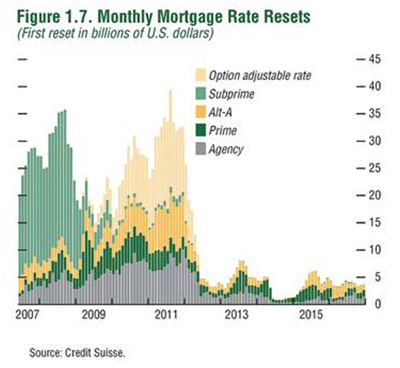
Like the Roaring Twenties of a century ago, the real estate bull market of the last ten years crashed in dramatic style in late 2008. The collapse of the residential market was led by massive defaults in ill-conceived ?sub-prime loans?. Millions of American homes are now in default and in the process of loan modification, abandonment or foreclosure. There is no end in sight as Prime, Alt-A, and Option ARM loan resets come due beginning in 2010.


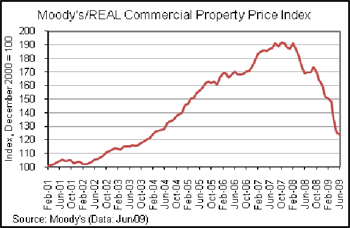
Lurking around the corner, literally unnoticed by the average American worried about keeping his home, is a similar crisis in commercial real estate. For over a year commercial property values have been plummeting and have not begun to recover. A drive through both major cities and suburbia tells the story. Vacant stores, empty shopping malls, cancelled mixed use developments and eerily empty car lots presage bad things to come.


We have discussed the origins of the housing crash before and the role played by feckless politicians and over-ambitious bankers. Now this crisis has spread to the commercial sector. Banks and commercial lenders saw in the new housing starts an equally promising demand for new shopping malls and suburban offices. Lenders forgot about pre-leasing requirements and made speculative loans on buildings that had no pre-leasing. As with housing, the rule book was thrown out the window. Like the aftermath of any wild party, there is hell to pay in the morning. It is morning in the commercial marketplace and the fat lady is singing.


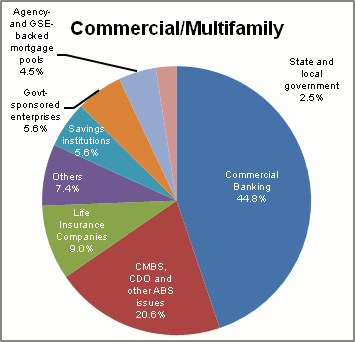
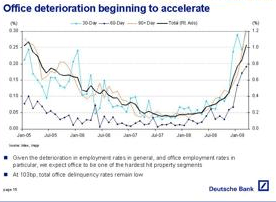
Depository institutions hold about half of the $3.2 trillion of debt on US commercial property. The default rate in the first quarter of 2009 was just 2.25%. Sounds OK until you do the math and realize that $36 billion was in default and it is just beginning. The FDIC puts troubled banks on ?the problem list?. In early 2008, there was one bank on the list. At the end of June 2009 there were 416, up from 305 at the end of the first quarter when the default rate was just 2.25%. Total assets at these problem institutions total $299 billion. The problem is that the total reserves of the FDIC are just $42 billion. The FDIC has closed over 100 banks and one good estimate is that they will close around 10% of US banks, 500 to 1,000, before the crisis runs its course. The losses will dwarf the $394 billion of the RTC and may surpass a trillion dollars. Is there any wonder why banks are loathe to make new loans?


So what happens to commercial real estate? With prices plummeting, there must be some great buys out there, one must assume. But do not bet on it. This was not just an earthquake. The plates shifted, and like musical chairs, when the music stops there will be fewer chairs and many people left standing. Consolidation is the next step. There will be the inevitable drop in rents and with it property values. The better and stronger tenants will flee the less attractive Class B and Class C space and move to Class A properties. Class A properties will survive due to full occupancy and stable cash flow. But the lesser properties that were leased will empty.


Like the suddenly quiet auto malls with the empty Pontiac, Saturn and Chrysler dealerships, lesser properties will lose their anchor grocery stores, Targets, and big box users. With the anchors gone, and traffic with it, the mom and pop small businesses cannot survive. There is no future for the marginal Class C shopping center. Tenants will flee to better locations and more affordable lease rates. Class A offices will survive. Well located and attractive Class B properties may muddle through at reduced revenues ? if they can survive the refinancing maze. But, the poorly located Class C office will remain a ?see-through? for years to come. Old, tired, and mostly vacant Class C office buildings line the crumbling freeways of Detroit, Cleveland, Youngstown, and countless smaller rust belt cities where excess capacity has eliminated the need for new development.


A year from now, the landscape of America will be forever changed. The office and retail markets will be vastly different than they look today. Not much of it will be good. Five years from now, will empty shopping centers and auto dealerships remain shuttered or will they be rebuilt or torn down and their use converted to something more productive? Will our politicians cease their meddling in the market and allow the market to heal itself? These are questions that will haunt our economy for the next decade.


***********************************


This is the fourth in a series on The Changing Landscape of America. Future articles will discuss real estate, politics, healthcare and other aspects of our economy and our society.


Robert J. Cristiano PhD is a successful real estate developer and the Real Estate Professional in Residence at Chapman University in Orange, CA.


PART ONE ? THE AUTOMOBILE INDUSTRY (May 2009)

PART TWO ? THE HOME BUILDING INDUSTRY (June 2009)

PART THREE ? THE ENERGY INDUSTRY (July 2009)

PART FOUR ? THE ROLLER COASTER RECESSION (September 2009)


Full story at http://feedproxy.google.com/~r/Newgeography/~3/f8cm0Yt_Ii0/001210-when-fat-lady-sings-the-fate-commercial-real-estate


Advertise with Us