PRESENTED BY PALAPPLE

ADVERTISE WITH US

Posted by iPhoto.org - Feb 26, 2009

Advertise here in this prominent space for only $100 per month, your advertisement will appear in all of the post pages available across this website.
Check out the link about for more advertisement options provided, get your message across!

Advertise with Us

SNAPSHOCK IS COMING TO TOWN

Posted by iPhoto.org On Feb 26, 2009

You better watch out,
You better bookmark,
You better ready your pics, cos I'm tell you why...

Snapshock is coming to town!!

Snapshock

THE BEST PLACE FOR DRY SEAFOOD

Posted by StarryGift On Mar 20, 2009

全香港其中一間最具規模的海味網上專門店。專營零售燕窩、鮑魚、海參、魚翅、花膠、元貝、冬蟲草,極具食療價值。此外亦提供各項中藥海味烹調方法,以導出各食品的固本培元及補生之效。

客戶服務熱線:3158 1276
傳真熱線:3158 1416
電郵查詢:info@starrygift.com

海味軒 | 香港燕窩海味網上專門店


Showing posts sorted by relevance for query china. Sort by date Show all posts

Thursday, December 2, 2010

China?s Urbanization: It Has Only Just Begun

In May, disgruntled workers of Honda factories in Zhongshan, southern China, went on strike at the Honda Lock auto parts factory and started posting accounts of the walkout online, spreading word among themselves and to workers elsewhere in China.


In June, Bloomberg reported that China, ?once an abundant provider of low-cost workers, is heading for the so-called Lewis turning point, when surplus labor evaporates, pushing up wages, consumption and inflation.? China had depleted its surplus labor; the period of cheap labor was over.


In the subsequent debate, some observers concurred with the observation that a turning point had arrived in China. Others noted that the conclusion is too simplistic because it does not fit into the big picture of China?s demography.


With the gloomy economic prospects in the advanced economies and relatively strong recovery in the large emerging economies, the debate is about to resurface.


Eclipse of ?Unlimited Supplies of Labor?


In 1954 Arthur Lewis published one of the most influential development economics articles, ?Economic Development with Unlimited Supplies of Labor,? which contributed to his Nobel Prize a quarter of a century later. In this paper, Lewis sought to provide a broad portrayal of the development process, based on the current state of the developing countries, the historical experience of developed countries, and some central ideas of the classical economists.


In the Lewis story a ?capitalist? sector develops by taking labor from a non-capitalist backward ?subsistence? sector. At an early stage of development, there would be ?unlimited? supplies of labor from the subsistence economy, which means that the capitalist sector can expand without the need to raise wages. The implication is that industrial wages in developing countries begin to rise quickly at the point when the supply of surplus labor from the countryside tapers off.


Lewis likely would have recognized the validity of his tipping point in the more prosperous first-tier cities of China where there clearly are increasing labor shortages and which thus reflect the world of classical economics. However, had he taken a tour in China?s smaller cities, or ventured into the countryside, he would have recognized there still remains ?unlimited supplies of labor? ? the world portrayed by the classical political economists, including David Ricardo, Adam Smith, and Karl Marx.


So has China reached the Lewisian tipping point? The answer is yes and no: in some regions yes, but in all of China, emphatically n no.


Urbanization and Growth through Tiered Cities


Starting in the 1980s, China's reform and opening up were initiated by the creation of the coastal special economic zones (SEZs), initially in the southern province of Guangdong, close to Hong Kong and Macao. Soon the reform extended from urban agglomerations such as Shenzhen and Guangzhou to other primary cities, from Beijing to Shanghai ? thanks to the colossal investment projects in Pudong which turned the swampland into an emerging global financial hub.


During the past decade, the economic success of these megacities has been spilling over into other tiers of Chinese cities. Even before the onset of the global financial crisis, second-tier cities ? such as Suzhou, Tianjin, Shenyang, Chengdu, Dalian and Chongqing ? had already attracted significant attention with investments from global corporate giants.


At the same time, third-tier cities, from Ningbo and Fuzhou to Wuxi and Harbin, have been following in the footprints of first- and second-tier cities. Behind these three tiers of rapidly-growing urban agglomerations, there are still others such as Kunming and Hefei, seeking to take advantage of the urban growth trajectories.


Some 60 years ago, Lewis saw something similar in several developing countries, with their polar opposites, vibrant and modern cities, and sleepy and traditional rural villages. ?There are one or two modern towns, with the finest architecture, water supplies, communications and the like, into which people drift from other towns and villages which might almost belong to another planet.?


Migration and the Turning Point


Paced by strong economic growth, China?s leading megapolises are also evolving very fast. The urbanization that took almost a century in the West is occurring in a decade or two in China. In 1979, Shenzhen was still a poor fishing village with some 20,000 inhabitants. In 2009, it had a population of 9 million, and income per capita exceeded $13,600, only $3,000 less than in Taiwan or South Korea. Now Shenzhen plans to achieve an average GDP per capita of $20,000 by 2015, the level of European countries, such as Portugal and Slovenia. In the latter, the real GDP growth will be more subdued in the coming years, at best. In Shenzhen and China?s other megacities, it will be around 10%.


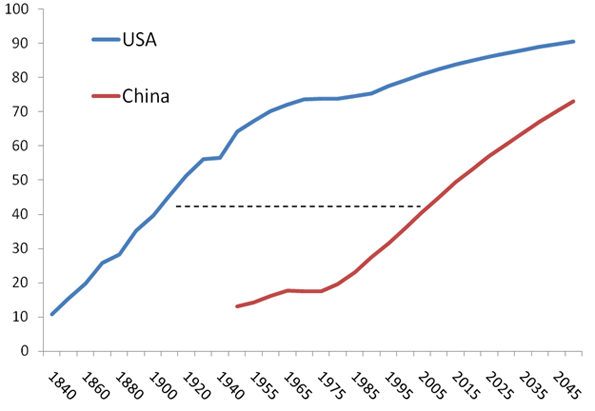
Yet, despite these colossal shifts, China?s urbanization still has a long way to go. In 1980, the U.S. urban population was 74% of the total; China?s comparable figure was only 19%. Today, America?s urban share of the population is more than 80%, whereas China?s remains less than 50%. Taken into consideration China?s colossal size and development level, this gap suggests extraordinary potential. In 2025, America will have two cities (New York and Los Angeles) with more than 10 million people, three with 5-10 million and 37 with more than a million. By then, China will have five cities with more than 10 million people, 9 with 5-10 million, and almost 130 with more than a million. Viewed this way, China?s urbanization has barely begun (Figure 1).


Figure 1: Percentage of Urban Population: United States and China

Winning China?s West

If Lewis had spent even some time in the rural China or the emerging new tiers of cities, he would have associated them with the world of ?unlimited supply of labor?.


During the past three decades, migrant laborers have played a key role in China?s economic growth in the first-tier cities. Now as living costs rise fast in Beijing, Guangdong, and the Yangtze River Delta region, employment prospects are improving in the inland cities and the West.


Since the early 2000s, the new ?Go West? policy covered the huge municipality of Chongqing, six provinces, from Gansu to Sichuan and Yunnan, and five autonomous regions. At the time, this region accounted for almost 30 percent of China?s population, but less than 17 percent of its GDP. Initially, the policy focused on the development of infrastructure (transport, hydropower plants, and energy and telecom establishments). But it is the new stage of development in eastern China that is now dramatically accelerating growth in the West.


Even before the global financial crisis, the Ministry of Commerce designated more than 30 ?priority relocation destinations? in China?s inland to increase the share in the processing industry in central and western areas, especially in labor-intensive manufacturing.


In the future, China?s West hopes to catch up with its East through domestic consumption, cost advantage, investment policies and infrastructure, which has been boosted by the nation?s stimulus policies. China?s West is about to experience a revolution in durable consumer goods, from color TV sets to refrigerators. True, the volume of retail sales remains higher in China?s East, but sales growth is stronger in the non-coastal areas.


As costs have risen, China has lost some jobs to Bangladesh, Vietnam and Cambodia, primarily for cheaper, labor-intensive goods like textiles, simple electronics, and toys. Yet, China?s West still offers many of the comparable benefits and an emerging infrastructure.


The Decades to Come


In the next two decades, China?s urbanization is expected to boost domestic demand by $4.5 trillion, which should assure a stable economic development even if exports decline. In effect, the urban migrants? demand for housing is likely to become the largest driving force for China?s economic growth in the future.


During the past three decades, the share of China's city dwellers has more than doubled to 45 percent. And by 2040, the urbanization rate is expected to be close to 67 percent. In the next three decades, the number of China's urban residents is expected to grow by 360 million people to 970 million. In terms of current urban populations, this is the same as creating city space for entire urban America (260 million), Japan (85 million) and another 15 million people - within one generation.


This great transformation, however, is predicated on sustained economic growth and a stable international environment. China?s first-tier cities are now coping with the coming of the Lewisian turning point/ The big story in the coming decades, will be the takeoff in the west and among many once peripheral cities. Due to China?s sui generis magnitude, this process will take another decade or two.


Dan Steinbock is Research Director of International Business at India China and America Institute (USA), and Visiting Fellow at Shanghai Institutes for International Studies (China).


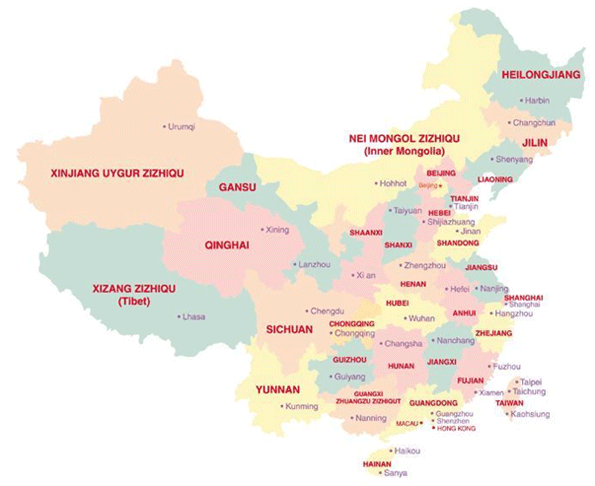
China?s Provinces and Cities

References


1 Hamlin, K. et al. (2010), ?China Reaches Turning Point as Inflation Overtakes Labor,? Bloomberg News, June 11.


2 On the argument that China is coping with the Lewisian turning point, see Cai, Fang, Wang, Meiyan, 2008. A counterfactual analysis on unlimited surplus labor in rural China. China & World Economy 6 (1), 51?65.; Fang Cai, Meiyan Wang (2010), ?Growth and structural changes in employment in transition China,? Journal of Comparative Economics 38 (2010) 71?81. On the argument that Lewisian turning point is years away, see Yang Yao (2010), ?No, the Lewisian turning point has not yet arrived,? Economist, July 16, 2010; Roach, S. (2010), ? Chinese wage convergence has a long way to go,? Economist, July 18.


3 Lewis, W. Arthur (1954). ?Economic Development with Unlimited Supplies of Labor,? Manchester School of Economic and Social Studies, Vol. 22, pp. 139-91


4 Steinbock, D. (2010),? Legacy of Globalization: Shanghai and Hong Kong as China?s Emerging Financial Hubs,? Policy Brief, Shanghai Institutes for International Studies, January 2010.


5 These tiers of cities are evolving dynamically and through a national plan. With its more than 31 million people, Chongqing, for instance, is already one of China?s five national central cities. National central cities have a great impact around the surrounding cities on integrating services in infrastructure, finance, public education, social welfare, sanitation, business licensing and urban planning.


6 In fact, Lewis?s classic article offers also another clue to assess China?s stages of growth. As far as he is concerned, small migrations explain little. In the 1950s, he noted, 100,000 Puerto Ricans emigrate to the United States every year. Still, it is Puerto Rican wages which are pulled up to the U.S. level. Mass immigration is quite a different kettle of fish. ?If there were free immigration from India and China to the U.S.A., the wage level of the U.S.A. would certainly be pulled down towards the Indian and Chinese levels,? Lewis argued. In China?s economic development, the tens of millions of migrant workers have played the comparable role of pulling down the national wage level.


7 In the beginning of the ?Go West? program, the largest proportion of the West?s total fixed asset investment was in infrastructure. And almost half of China?s huge stimulus of $586 billion was earmarked for transportation, infrastructure and power grids. These, in turn, facilitate the exploitation of minerals, natural gas and oil in China?s West. In addition to the stimulation of domestic demand, the government?s strategy is to ?cultivate areas of high consumer demand and expand consumption in new areas?.


8 ?China's urbanization to fuel domestic demand,? China Daily, November 15, 2010.


9 Steinbock, D. (2010), ?Growth fueled by urban investment,? China Daily, February 25, 2010.


10 On the international relations dimensions of China?s stages of growth, see Steinbock, D. (2010), ?China?s Next Stage of Growth: Reassessing U.S. Policy toward China,? American Foreign Policy Interests, No 6, December 2010.


Full story at http://feedproxy.google.com/~r/Newgeography/~3/Em5CTa7cHWo/001906-china%E2%80%99s-urbanization-it-has-only-just-begun

Wednesday, July 21, 2010

Distilling China?s Development

The economic rise of China has created two growth industries pulling in opposite directions. There?s either the school of blind praise of ?The China Miracle? or its opposite, apocalyptic predictions about the country?s impending implosion.


On the surface, it appears as if the fundamentals of China?s modernization are similar to what the Western nations went through in the past, that is, a mass migration of farmers from the countryside to the urban centers to work in factories and construction sites. Taking into account the enormous scale at which this migration is happening, the country seems to be moving toward what some observers are dubbing the ?Chinese Century?.


Similarities aside, however, China?s development is uniquely Chinese. Whereas the U.S. was built upon the backs of immigrants from outside of its borders, China?s development owes its current success to its own huge population. China will never become a nation of external immigrants and will remain a homogenous behemoth long into the future.


China?s current condition and its immediate future remain shrouded in a state of unsettling mystery. Having lived and worked as an architectural designer in China for nearly a year now, my own fervent curiosity has hardly been assuaged. There are a few things I?ve learned though that should be clarified regarding China?s development. Following, I will attempt to belie some common misconceptions.


Misconception: As China continues develop, it will become more open to outside influence and the government system will reform itself to become more democratic and free.


To the naive Western observer, China?s continued economic evolution means that the country must allow more democratic freedoms in order to remain competitive in the future. This assumption is extraordinarily dubious. China?s model is top-down, centralized planning and it has proven to be successful. To argue that it will not continue to work for China is a biased Western-projected fantasy.


A pre-existing culture of collectivism constitutes one reason why state-driven development continues to blaze forward totally unhinged. When it comes to sensitive issues like media censorship or human rights, most Chinese citizens passively shrug their shoulders knowing full well that protesting will ultimately prove futile and self-defeating. Furthermore, most citizens are too busy hustling to make money and pull themselves up the socioeconomic ladder to be concerned with such matters.


Perhaps the past two centuries of Chinese history will offer some clues into why the status-quo is so apathetically accepted. China?s experience of 19th and 20th Centuries consisted largely of a series of hardships: the Opium Wars to the fall of the Qing Dynasty, the subsequent Japanese Invasions and Chinese Civil War, and concluding with Mao?s Cultural Revolution. It is obvious that China is much better off now than it has been for the past 200 years.


This might explain why China?s populace is now seizing the unique opportunity of ?reform and opening? to make the best out of the current situation. It might also explain why people are reluctant to disrupt the established order. Thought about in this way, China?s current system of rule is not so much a 'big-brother? entity as it is an unspoken collective social contract to keep peace.


Misconception: China?s rise to global prominence is over estimated. The looming real estate bubble in China means that economic collapse is imminent.


Doomsday predictions about China?s collapse have become something of a growth industry. Commentators like Gordon Chang and hedge fund manager James Chanos are placing their bets on China?s demise. Many of these criticisms stem from what is speculated to be a coming crash in the real estate market.


To the central government, constructing new buildings is much more than just providing new and modern accommodations for the populace; it stands for social stability. It doesn?t take an economist to acknowledge that city-building is an important part of economic growth. But what is often overlooked is how city-building is a key part of the modernization process, employing rural migrants and giving them opportunity to earn substantially more than they could as farmers.


In China, real estate development is only one part of economic growth equation. Chinese leaders are well aware that the mad pace of constructing new buildings cannot last forever and already there seems to be an overabundance of supply in the residential and commercial sectors in first-tier cities like Shanghai and Beijing. Yet China is not anywhere near finished with its construction boom as 2nd, 3rd and 4th tier cities race ahead to catch up with their 1st tier counterparts.


Looking into the future, China?s leaders are preparing to shift the economic growth to more information-based sectors. The city I live in, Chengdu, the capital of Sichuan province, has already recruited American heavy-hitters such as Cisco and Intel. Chengdu has been successful in doing this by investing in new infrastructure and developing a series of high-tech industrial zones that give foreign companies the option of lower operational costs than found in the increasingly pricey coastal cities.


Misconception: Revaluing China?s currency will help bring manufacturing jobs back to the U.S.


China?s economy would not be the success it is today without the foreign investment that flooded through the gates since they first opened in 1978. The number of foreign enterprises directly benefitting from the low cost of labor in China has expanded greatly since that time. China?s maintaining a low valuation of its currency, the Renminbi (RMB), has been a key factor in attracting and keeping investment from overseas businesses.


Yet the talking heads in Washington have taken to pressuring China to revalue the RMB in order to help ?rebalance the global economy?. Just ahead of the G20 last month, Treasury Secretary Timothy Geithner told Congress that China?s RMB peg to the U.S. dollar is an ?impediment to sustainable global growth.? Responding to the pressure, China announced that it would in fact let the RMB appreciate against the dollar.


Following China?s announcement, the RMB rose a whopping .4% in value leading to what Economist Paul Krugman called the ?Renminbi Runaround?. Krugman is correct to call out China on its currency manipulation- but it should be no surprise that what China is doing is simply looking out for its own national interests. A rapid rise in RMB value would cause some serious damage to the Chinese economy.


American politicians know this but will continue to pressure China to raise the RMB value to score brownie points with their constituents. The reality is that both China?s economy and foreign companies using Chinese labor benefit from the low value of the RMB. For instance, companies such as Apple would not be able to sell their much coveted iPads at reasonable prices if it were not for cheap Chinese labor.


Pressuring China too much could result in a trade war which would in fact not only hurt Chinese exporters but the American consumer as well. Politicians are also deluded into thinking that manufacturing jobs will come back to the U.S. if China?s RMB goes up. On the contrary, companies will move manufacturing operations to some other place where regulations and labor costs remain substantially lower.


Conclusion: China?s accomplishments over the past two decades are unprecedented and fascinating. The scale at which change is happening means that complexity and uncertainty are unavoidable facts of life. Many challenges lie ahead, both for China?s domestic issues and its relationship with the rest of the world. As far as China has come, there still is a long way to go as millions still aspire to a better life.


Adam Nathaniel Mayer is a native of California. Raised in Silicon Valley, he developed a keen interest in the importance of place within the framework of a highly globalized economy. Adam attended the University of Southern California in Los Angeles where he earned a Bachelor of Architecture degree. He currently lives in China where he works in the architecture profession. His blog can be read at http://adamnathanielmayer.blogspot.com/


Photo by DavidM06


Full story at http://feedproxy.google.com/~r/Newgeography/~3/b_elK5mzkEk/001681-distilling-china%E2%80%99s-development

Friday, October 29, 2010

Misguided Love Affair with China; China's Massive Monetary Expansion and Crackup Boom

China is pointing the finger at the US, complaining about "Out of Control" US dollar Printing by the Fed.
Dollar issuance by the United States is "out of control", leading to an inflation assault on China, the Chinese commerce minister said in comments reported on Tuesday.

"Because the United States' issuance of dollars is out of control and international commodity prices are continuing to rise, China is being attacked by imported inflation. The uncertainties of this are causing firms big problems," Chen was quoted as saying by the official Xinhua news agency.

Chinese officials have criticised U.S. monetary policy as being too loose before, but rarely in such explicit language.
Decoupling Theories Renewed

I will get to loose monetary policy in just a bit, but first consider More than decoupled, China is in league of its own
Two years on from the global financial crisis, the contrast with the rich world is striking. In the United States and Europe, growth is sluggish, a slump into outright deflation is a real risk and central banks look set to loosen policy further.

So the evidence is in: China is decoupled, influenced by, but ultimately independent from other major economies.

"The crisis was a test and China passed the test. Decoupling has become a much more solid thesis now than three years ago when we only talked about it hypothetically," said Qing Wang, Morgan Stanley's chief economist for greater China.
Chinese Money Supply Numbers from People's Bank of China


Money and Quasi Money Jan 2009 - 496135.31
Money and Quasi Money Sep 2010 - 696384.86

"Out Of Control" Monetary Expansion Irony

I am certainly not about to defend the Fed's misguided policies, but the complaint from Chinese commerce minister that US monetary printing is "out of control" is the ultimate in "pot calling the kettle black" irony.

Over the past few weeks I have exchanged quite a few Emails regarding China with my friend "BC" who writes ...
Total Chinese money supply is up over 4 times since '03, a 17%/yr. rate at a doubling time of just 4 years; up 66% since Jan. '08, a 19%/yr. rate at a doubling time of 43 months; and up 40% since Jan. '09, a 20%/yr. rate at a doubling time of 40 months.

Knowingly or otherwise, China has experienced a textbook faster-than-exponential money and debt/asset blow off or crack-up bubble that mathematically cannot continue. All faster-than-exponential bubbles burst and collapse, with prices falling back to the levels at which the differential rate of GDP and money began to diverge at an order of exponential magnitude, which was around early '02.

Ironically, Bubble Ben bashers claim the Fed is going off the rails with debt-money reserve growth?! Imagine what would happen to the Renminbi were the currency to be floated/convertible with money growing at arguably near hyper-inflationary rates in China!

Do Schiff, Faber, or Rogers ever talk about China's reckless, hyper-inflationary money supply growth? This kind of money supply growth is banana republic-like, making our feeble efforts appear benign by comparison.

This situation is INSANE, and the crash coming in China-Asia will be unprecedented in world history.
Credit Expansion in US vs. China

One might think that a country whose money supply is doubling every 40 months and growing exponentially since 2003 would not be pointing the finger elsewhere, complaining that others are "out of control".

One might also think those screaming about hyperinflation would scream about happenings in China, not just the US.

One would be wrong on both counts.

Moreover, unlike US monetary expansion that sits as excess reserves, China's money supply growth has spawned massive lending sprees, property bubbles, and asset bubbles in general.

I spoke briefly of this in Massive Inflation in China, US Inflation Nonexistent

In a fiat credit-based society, credit-expansion not reserve-expansion is the key to understanding inflation. Credit is contracting in the US but running rampant in China. It should be no wonder China shows signs of an inflationary crackup boom and the US is mired in deflation.

Peak Oil and the Demand for Resources

In my recent interview with Chris Martensen (see "Straight Talk" with Economic Bloggers) a pertinent question came up regarding energy.
2. Many of our readers have subscribed to Chris' position that the economy must be increasingly interpreted through two other lenses; energy and other environmental resources. Can you comment on the Three E's?

Mish: I am a firm believer in peak oil. I don't know how anyone can deny it. Given peak oil, and given the demand from China for oil and other commodities, the world is on a crash course of demand that cannot be filled.

China is growing at 8-10% a year (assuming you believe the stats). Can China keep growing at that rate forever? For even 10 more years? What about India? Brazil?

Either we get some serious energy breakthroughs, China slows, or the standard of living drops in the US, UK, and Europe. Well China does not want to slow, and the US and Europe are fighting hard to maintain a standard of living that is not sustainable.

Historically these situations end up with war. That is an observation, not a prediction.

Something has to give, perhaps many things, but all of the people who think China will soon be the number one economy in the world and that China's growth is sustainable, better start thinking about the implications of what I just typed above.

Preparation For War?

My friend "BC" writes ...
China's behavior since 9/11 and the invasion and occupation of Afghanistan and Iraq by the US is reminiscent of nations' war preparations of the past.

Then again, given Peak Oil, China's increasing dependency on imports of oil and other mineral resources, and the extent to which the US imperial military is arming the Middle East, encircling Iran and Pakistan, and encroaching deeper into Central Asia and towards China's western frontier, why would the Chinese not be preparing for war (or at least war-like conflict in regards to trade and resources)?
Runaway Printing Fuels Crackup Boom

It is important to understand the drivers behind China's growth.

1. Rampant monetary expansion
2. Property bubbles including completely vacant cities
3. US and European outsourcing
4. Malinvestment in infrastructure

Those who claim China's growth is internal fail to factor in points 2 and 4.

"BC" writes ...
China's runaway growth is derivative of US firms' massive investment in China-Asia, which has occurred recently coincident with Peak Oil, peak US Boomer and EU demographics, and now China reaching terminal velocity of investment, production, and credit growth.

That the US and EU economies (60-65% of world GDP) can no longer grow because of demographics and Peak Oil, and China is heavily dependent upon global markets for continuing US firms' investment and derivative growth of Chinese domestic investment, production, and exports, Peak Oil and China's terminal velocity occurring for the largest credit bubble per GDP in history implies that China faces an unprecedented contraction, with the risk that GDP per capita will fall at least 50% in the coming decade.
China bank profits defy loan problems

Much the same way the US housing bubble did not matter until it did, China bank profits defy loan problems
Bank of China and Agricultural Bank of China both reported rises in net profit of nearly 30 per cent in the third quarter in spite of government attempts to slow new lending and rein in asset prices.

The banks are the first of China?s state-controlled lenders to report profits for what is expected to have been a bumper quarter for most of their competitors as well.

However, the banks face problems involving bad loans resulting from a government-directed lending binge launched to combat the financial crisis.

Analysts, regulators and even the banks warn that the big expansion in lending, with the volume of new loans doubling from a year earlier to Rmb9,600bn in 2009, will almost certainly lead to a large rise in non-performing loans as many borrowers eventually default.

With credit still relatively easy to obtain and with economic growth still above 9 per cent, many of those asset problems are yet to materialise.
Love Affair Will End Badly

Parabolic expansion of housing prices, credit, or asset prices never ends well. Yet because the US bubble has burst while the various Chinese bubbles have not, various economic pundits are chanting nonsense once again about decoupling scenarios, even in the midst of currency wars and competitive currency debasement.

This love affair with China will not end well for the US, for China, and especially for the commodity producers like Australia and Canada, each in huge denial about their own property bubbles.

Mike "Mish" Shedlock
http://globaleconomicanalysis.blogspot.com
Click Here To Scroll Thru My Recent Post List


Full story at http://feedproxy.google.com/~r/MishsGlobalEconomicTrendAnalysis/~3/HtveckbPYEI/misguided-love-affair-with-china-chinas.html

Tuesday, June 22, 2010

Why China's Yuan Announcement Is Completely Meaningless

robert reich

The stock market is euphoric over China’s apparent decision to allow its currency to rise against the dollar.


Watch your wallets.


China isn’t really changing anything. It’s only doing the minimum to prevent Congress from listing China as a currency manipulator, leading to a squeeze on Chinese imports.


Over time – and I’m talking about months if not years – China will raise its currency to where it was before the global meltdown in 2008. Big deal.


Even then, a stronger yuan won’t generate lots of new jobs in the United States


That’s because most of the gains of China’s meteoric growth are still not finding their way into the hands of Chinese consumers, whose spending is growing far more slowly than China’s overall economy. In 2009, total personal consumption in China amounted to only 35 percent of the economy; ten years ago it was almost 50 percent.


Why are Chinese consumers so reluctant to spend? First, social safety nets are still inadequate there, so Chinese families have to cover the costs of health care, education, and retirement. (China recently doubled its spending on these services but the total is still low by international standards – around 6 percent of the Chinese economy, compared with an average of around 25 percent in most developed nations.)


Second, young Chinese men outnumber young Chinese women by a wide margin, so households with sons have to save and accumulate enough assets to compete successfully in the marriage market.


Third, Chinese society is aging quickly because the government has kept a tight lid on population growth for three decades. That means households are supporting lots of elderly dependents and must save in anticipation of supporting even more.


But most fundamentally, China is oriented to production, not consumption. It wants to become the world’s preeminent producer nation. While keeping the yuan artificially low is costly to China — it pushes up the prices of everything China imports — China is willing to bear these costs because its currency policy is really an industrial policy.


We think the basic purpose of an economy is to consume, not to produce. So we only grudgingly support industrial policy. We think of government efforts to rebuild our infrastructure as a “stimulus.” We approve of government investments in basic research and development mainly to make America more secure through advanced military technologies. And we give American companies tax credits for R&D wherever they do it around the world.


Don’t be fooled into thinking that US companies will continue to make big profits from sales in China. China allows big U.S. and foreign companies to sell in China on condition that production takes place in China – often in joint ventures with Chinese companies. It wasn’t American know-how, so it can eventually replace the US firms with China firms.


GM’s China sales are soaring but it’s making those cars there. It’s even designing and developing a new subcompact for China, in China. Proctor & Gamble is so well-established in China that many Chinese think its products (such as green-tea-flavored Crest toothpaste) are local brands. They might as well be. P&G makes most of them there.


Other American are helping China build a “smart” infrastructure, tackle pollution with clean technologies, develop a new generation of photovoltaics that convert solar radiation into electricity and wind turbines, find new applications for “nanotechologies,” and build commercial jets and jet engines. GE was producing wind turbine components in China.


Even if some of this enhances the profits of American-based companies, it doesn’t translate into more jobs in the United States. And it doesn’t build know-how here. It builds it there.


China’s currency policy also doubles as a social policy designed to maintain order. Each year, tens of millions of poor Chinese pour into China’s large cities from the countryside in pursuit of better-paying work. If they don’t find it, China risks riots and other upheaval. Massive disorder is one of the greatest risks facing China’s governing elite. That elite would much rather create export jobs, even at the high cost of subsidizing foreign buyers, than allow the yuan to rise much against the dollar and thereby risk job shortages at home.


Here’s the awkward truth that’s not openly discussed on either side of the Pacific: Both the United States and China are capable of producing far more than their own consumers are capable of buying. In the United States, the root of the problem is a growing share of total income going to the richest Americans.


Inequality is also widening in China, but the root of the problem there is a declining share of fruits of economy growth going to average Chinese and increasing share going to capital investment.


Both our societies are threatened by the disconnect between production and consumption. In China, the threat is civil unrest. In the United States, it is a prolonged jobs and earnings recession which, when combined with widening inequality, could create a political backlash.

Join the conversation about this story »


Full story at http://feedproxy.google.com/~r/businessinsider/~3/PNPX6_-QcHw/why-chinas-yuan-announcement-is-totally-meaningless-2010-6

Wednesday, March 17, 2010

Pressure Increasing on China to Revalue Yuan; What Can Go Wrong?

Pressure on China to do something about its allegedly undervalued currency is mounting by the day. Please consider the following articles.

World Bank Calls For Stronger Yuan

The World Bank Says China Must Pare Stimulus to Counter Bubbles
The World Bank indicated that China, the world?s third biggest economy, should raise interest rates to help contain the risk of a property bubble and allow a stronger yuan to help damp inflation expectations.

The nation?s ?massive monetary stimulus? risks triggering large asset-price increases, a housing bubble, and bad debts from the financing of local-government projects, the Washington- based World Bank said in a quarterly report on China released in Beijing today. The group raised its economic growth forecast for this year to 9.5 percent from 9 percent in January.

The World Bank?s call echoes the assessment of private economists -- analysts at Morgan Stanley this week said higher reserve requirements for banks may be ?imminent? and interest rates could start to climb as early as next month. China?s economic rebound has also sparked increasing calls for an end to its exchange-rate peg to the dollar, adopted in mid-2008 to help shelter exporters amid the global recession.
Senate Considers Currency Manipulator Regulation

Bloomberg is reporting Senate May Force Obama to Take Tougher Yuan Stance
Five senators including Charles Schumer of New York and Lindsey Graham of South Carolina introduced legislation yesterday to make it easier for the U.S. to declare currency misalignments and take corrective action. Even if the bill stalls, it may have ?ripple effects? that lead the Treasury Department to declare China a currency manipulator, William Reinsch, president of the National Foreign Trade Council, said.

Obama?s goal of doubling U.S. exports in five years depends on his ability to get China to raise the value of its currency, said Sherrod Brown, an Ohio Democrat and co-author of the legislation. China?s intervention in currency markets to keep the value of the yuan, or renminbi, at a set value acts as a subsidy to exports and tax on imports, Brown said at a news conference yesterday.

Senator Debbie Stabenow, a Michigan Democrat, and Sam Brownback, a Kansas Republican, are also supporting the legislation. Graham is a Republican and Schumer is a Democrat.

The senators said the U.S. recession could boost the political prospects for the legislation, which Schumer has proposed in various forms since 2003. Schumer said the Senate proposal will be attached ?very soon? as an amendment to ?must-pass legislation.?

?The only way we will change them is by forcing them to change,? Schumer said.

The yuan is undervalued by as much as 40 percent, which is ?blatant protectionism,? Bergsten said. Brown and Schumer quoted the analysis of Bergsten and Nobel Prize winning economist Paul Krugman in support of their efforts.
Business Sours On China

Please consider Business Sours on China.
China's relationship with foreign companies is starting to sour, as tougher government policies and intensifying domestic competition combine to make one of the world's most important markets less friendly to multinationals.

Patent rules imposed Feb. 1 threaten to increase costs in China for foreign innovators in industries such as pharmaceuticals, and let authorities force foreign drug companies to license production to local companies at state-set prices.

A year ago, in a move foreign critics called protectionist, Chinese regulators rejected a bid by Coca-Cola Co. for China Huiyuan Juice Group Ltd., saying it could crowd out smaller companies and raise consumer prices. The two combined held just a fifth of China's juice market.

In July, four executives of Anglo-Australian mining giant Rio Tinto were detained, initially accused of stealing "state secrets," amid tense negotiations between global miners and China's steel industry over iron ore prices. Rio Tinto denies wrongdoing by the men, who await trial on reduced charges of bribery and theft of commercial secrets.

Google Inc.'s woes highlight the angst. The search company, long troubled by Chinese censorship rules, threatened Jan. 12 to depart China after it said a Chinese hacking attack penetrated its computer network. Related attacks hit dozens of other multinationals. Google is expected soon to close its Chinese site, Google.cn., leaving local companies dominating an Internet market of 400 million users.

"The Google issue has had a crystallizing effect," says Lester Ross, managing partner in Beijing for U.S. law firm Wilmer Cutler Pickering Hale and Dorr. "It raised the consciousness of government and of the boardrooms and other stakeholders" about the difficulties of doing business in China, he says.
Krugman Wants To Take On China

Inquiring minds are reading Taking On China by Paul Krugman.
Tensions are rising over Chinese economic policy, and rightly so: China?s policy of keeping its currency, the renminbi, undervalued has become a significant drag on global economic recovery. Something must be done.

Today, China is adding more than $30 billion a month to its $2.4 trillion hoard of reserves. The International Monetary Fund expects China to have a 2010 current surplus of more than $450 billion ? 10 times the 2003 figure. This is the most distortionary exchange rate policy any major nation has ever followed.

So how should we respond? First of all, the U.S. Treasury Department must stop fudging and obfuscating.

If Treasury does find Chinese currency manipulation, then what? Here, we have to get past a common misunderstanding: the view that the Chinese have us over a barrel, because we don?t dare provoke China into dumping its dollar assets.

It?s true that if China dumped its U.S. assets the value of the dollar would fall against other major currencies, such as the euro. But that would be a good thing for the United States, since it would make our goods more competitive and reduce our trade deficit. On the other hand, it would be a bad thing for China, which would suffer large losses on its dollar holdings. In short, right now America has China over a barrel, not the other way around.
Looking At Half The Equation

For starters, Krugman conveniently ignores one side of the equation.

A sinking dollar is good for exports, however, given China's regulatory policies as noted in Business Sours on China, it's not at all clear exports to China would rise by much. Indeed, I suspect that China's regulatory restrictions are a far bigger impediment to trade than currency fluctuations.

Furthermore, one cannot (or at least should not) ignore what would happen to the price of imports. A falling currency is not a free lunch.

While I agree with Krugman that China would not dump US Treasuries, the idea that the U.S. has China over a Barrel because is preposterous. Mutual deadly embrace with unbalanced winners and losers is more like it.

What China Can and Cannot Do With Reserves

Please consider What the PBoC cannot do with its reserves by Michael Pettis.
It is a real toss-up as to which generates more bizarre comment in the international press: Beijing?s long-feared dumping of US Treasuries, or the use and value of the PBoC?s central bank reserves. The revelation last week that Chinese holdings of US Treasury obligations fell in December by $34.2 billion, to $755.4 billion, generated a frisson of fear and excitement, leading one prominent newspaper to worry that ?If there is one thing that gets investors twitchy, it is the fear that China is losing its appetite for US government bonds.?

Remember that China has a large current account surplus which necessarily must be recycled abroad, and the US has a large current account deficit which necessarily must be funded abroad. It would be astonishing if, under these circumstances, total Chinese holdings of USD assets declined, and of course it is impossible that they declined faster than the willingness of other foreigners to replace them.

If China runs a current account surplus, it must accumulate net foreign claims by exactly that amount, and the entity against which it accumulates those claims (adjusting for actions by other players within the balance of payments) ultimately must run the corresponding current account deficit. And as long as China ran the largest current account surplus ever recorded as a share of global GDP, and the US the largest current account deficit ever recorded, and especially since China also ran an additional capital account surplus (i.e. other non-PBoC agents ran a net capital inflow), it was almost impossible for the PBoC to do anything but buy US dollar assets. Given the sheer amounts, a substantial portion of these assets had inevitably to be USG bonds.

This was not a discretionary lending decision. It is the automatic consequence of China?s currency regime, in which it pegs the RMB to a foreign currency, in this case the dollar. Why? Because when the PBoC decides on the level of the RMB against the dollar, it does not do so by passing a law, and making it a capital crime for anyone to trade at a different price. What it does is far simpler. It offers to buy or sell unlimited amounts of RMB against the dollar at the desired price.

If it stops buying dollars, it must let the market decide by itself on the new equilibrium price of the dollar. In that case the value of the dollar has to plunge in RMB terms (or the RMB soar, which is the same thing) in order for buyers and sellers to match up and for the market to clear. The moment the PBoC stops buying, in other words, the RMB will rise in value ? and so it cannot stop buying in anticipation of the RMB rising in value, as the FT article suggested.

Here is where things get interesting. China?s reserves are often thought of as if they were a treasure trove available for spending. They are not. They are simply the asset side of the mismatched balance sheet. If the PBoC wanted to ?spend? $100, say for example to recapitalize a bank, it could do so, but this would automatically create a $100 dollar hole in its balance sheet. ? it would still owe the RMB that it borrowed originally to purchase the $100. To put it another way, the reserves are not a savings account, free for the PBoC to spend as it likes. Reserves are effectively borrowed money.

So what are reserves good for? As long as China maintains its own currency and denominates all domestic transactions in RMB, the PBoC reserves cannot be used in China. They cannot go to pay doctors? salaries, to build bridges, to lower taxes or to subsidize consumption. They can only be used to purchase or pay for things from outside China. This means that reserves ensure that China can import foreign commodities and other goods as long as it can pay for them domestically. It also means that the PBoC can ensure the availability of dollars to repay foreign debt and foreign investment. .....

... if the RMB is revalued by 10%, the value of the PBoC?s assets will immediately decline by $250 billion in RMB terms. Since the Chinese measure their wealth in RMB, isn?t this a real additional loss for China?

No, because remember that the only thing you can do with reserves is pay for foreign imports or repay foreign obligations. And just as the value of the reserves drops 10% in RMB terms, so does the value of all those foreign payments ? by definition they must go down by exactly the same amount in RMB terms.

This means that China takes no loss. It can buy and pay for just as much ?stuff? after the revaluation, and with less implied PBoC borrowing, as it could before the revaluation ? and the real value of money is what you can buy with it. So the real value of the reserves hasn?t changed at all ? just the accounting value in RMB, but this simply recognizes losses that were already taken long ago when the trade was first made, and should be a largely irrelevant number (except perhaps for conspiracy theorists).
Yuan is Undervalued by as Much as 40 percent?!

For the sake of argument, let's assume The RMB is undervalued by 40%. Who is the winner?

To answer the question let's return to a snip from Pettis:

"generally speaking China is likely to gain from a revaluation because after the revaluation it will be exchanging the stuff it makes for stuff it buys from abroad at a better ratio. The value of what it sells abroad will rise relative to the value of what it buys from abroad, and if we could correctly capitalize those values on the balance sheet, it would probably show that the Chinese balance sheet would improve with a revaluation of the RMB."

If that is true generally speaking, then the US is a beneficiary now, generally speaking. This implies we should be careful of what we ask. However, the situation is more complex because as Pettis explains there are individual winners and losers:

"
..it is not whether or not China as a whole loses or gains from a revaluation that can be measured by looking at the reserves, and I would argue that it gains, but how the losses are distributed and what further balance sheet impacts that might have."

Shock Effect

Let's consider the global shock effect of a sudden large revaluation of the Renmimbi. The key is the RMB does not float. To get a 40% rise in valuation, China must
buy or sell unlimited amounts of RMB against the dollar to maintain the desired price. That might mean a huge hike in Chinese interest rates to make holding the RMB attractive.

In turn, sharp interest rate hikes would likely cause a huge slowdown in China, decreasing China's demand for imports. This is yet another factor that Krugman and those crying "currency manipulator" miss.

And should the US impose a revaluation via tariffs, I would like to point out a little thing called Smoot-Hawley.

By the way, I am all in favor of a huge slowdown in China. I think China is on an unsustainable course, and the sooner and harder China slows the better for everyone in the long run.

However, the consequences of such a slowdown would be huge on the commodity exporters like Canada and Australia. Moreover, a slowdown in trade would slow global consumption.

I happen to think those are necessary adjustments along with more debt writeoffs, but believers in free lunches and Keynesian claptrap sure won't see it that way.

Hopefully this gives you a bit more of an idea as to just what might go wrong with all these simplistic "the Yuan is 40% undervalued - so label China a currency manipulator" ideas floating around.

Mike "Mish" Shedlock
http://globaleconomicanalysis.blogspot.com
Click Here To Scroll Thru My Recent Post List


Full story at http://feedproxy.google.com/~r/MishsGlobalEconomicTrendAnalysis/~3/3lwnBjOrIXw/pressure-increasing-on-china-to-revalue.html

Friday, December 18, 2009

China Faces Crash Scenario

Problems in China continue to mount. Money supply is growing rampantly out of control, property prices are in a bubble, exports are weak, commodity speculation is pervasive, and GDP growth is more of a mirage than real.

Money Supply Growing Record 29.74%

Please consider China Monthly New Loans Are 294.8 Billion Yuan, Above Forecast
New local-currency loans totaled 294.8 billion yuan ($43.2 billion), compared with 253 billion yuan in October, according to data released by the People?s Bank of China on its Web site today. The median forecast of 19 economists in a Bloomberg News survey was 250 billion yuan.

M2, the broadest measure of money supply, rose a record 29.74 percent in November from a year earlier.

China?s banking regulator plans to slow new lending to between 7 trillion yuan and 8 trillion yuan next year, a person familiar with the matter said this week. China is trying to ensure that there is enough credit to support an economic recovery without increased risks of bad loans and asset bubbles.

?We believe slower credit growth in 2010 will be key to avoid a boom-bust scenario in the economy,? Wang Tao, a Beijing-based economist for UBS AG, said in a report.
What is China doing with all that printing?

Please take a A 4-Minute Tour of the China Property Bubble to find out.

The world's largest shopping mall, South China Mall in Guangzhou, China, is almost entirely empty. Click on the link to see a fascinating video.

China Plans To Control Property Prices

Please consider China Can Boost Growth as It Cools Property, Merrill Says.
The government ?plans to control property prices by accelerating property investment and increasing supply,? economists Lu Ting and T.J. Bond said in an e-mailed note today. That contrasts with efforts in 2006 to cool prices by controlling investment, the economists said.
China Is Overbuilding Already

Note the insanity. China want to control prices by building more. It already has completely empty shopping centers, condos, and even a completely empty city.

China's Empty City


That is an amazing video of a completely empty city.

China Has Trouble Maintaining Demand Growth

In spite of obvious speculation and overheating in the housing sector, China Faces Difficulties in Maintaining Demand Growth.
China, the world?s third-largest economy, faces ?increased difficulties? in maintaining growth in domestic consumption, the nation?s top economic planning agency said.

A recovery in external demand is ?difficult,? the National Development and Reform Commission said on its Web site today, citing Vice Chairman Du Ying. The nation?s economic recovery ?is not yet solid,? the agency known as NDRC said.

China will maintain a ?moderately? loose monetary-policy stance and ?proactive? fiscal policies in 2010 as its economic recovery isn?t solid yet, the official Xinhua News Agency said Dec. 7, citing a statement by the annual central economic work conference.

The country still faces a ?very challenging? international environment and ?the domestic problems it is confronted with are also complicated,? Du said in the statement today. ?The potential risks in the fiscal and financial sectors can?t be underestimated,? Du said.

Economic growth in China, which is spending $586 billion on a stimulus package, accelerated to 8.9 percent in the third quarter after slipping to 6.1 percent in the first. The government is targeting 8 percent growth for the full year.
Moderately Loose Monetary Policy?!

What would a "loose" policy look like? Regardless, when Vice Chairman Du Ying says the "recovery is not solid" and the environment is "very challenging" you can take his word for it. Actually you can look at money supply growth and empty cities and conclude the same thing.

Bear in mind that China calculates GDP a peculiar way, as soon as the money is allocated. Much of that GDP growth is a mirage. Moreover, much if not most of what isn't a mirage, is nothing more than property malinvestment and other speculation.

Bubble Concerns In ?Sizzling? Shanghai

Please consider ?Sizzling? Shanghai Homes Defy Tax, Bubble Concerns
Escalating prices in Pudong, transformed within two decades from vegetable fields to skyscrapers for Citigroup Inc. and HSBC Holdings Plc, underscore a Chinese property market that set record highs this year after the government unleashed $1.3 trillion in new bank lending to counter the global recession.

Premier Wen Jiabao said Nov. 28 that property speculation must be suppressed, and the government on Dec. 9 reinstated a sales tax on homes sold within five years of purchase after reducing the period to two years in January. That change is superficial and will have minimal impact, said Lu Qiling, an analyst at Shanghai Uwin Real Estate Information Services Co.

?It?s only a token measure,? Lu said. ?It won?t change the upward trend in housing prices.?

?The government is clearly in a dilemma,? Luk said. ?It wants to address the surging property prices and concerns on bubble-bursting, yet it dares not take drastic measures for fear of hitting the market too hard.?

The nation?s real estate and stock markets are a ?bubble? that will burst when inflation accelerates in 2011, former Morgan Stanley chief Asian economist Andy Xie said in an interview in Hong Kong today.

?China?s asset markets are a Ponzi scheme,? said Xie, now a Shanghai-based independent economist. ?Property is heading for one huge bust that will take a year and a half to unfold.?

The Shanghai Property Index, which tracks 33 developers listed in the city, has more than doubled this year, compared with a 75 percent gain for China?s benchmark Shanghai Composite Index.
True Believers

Lu Qiling sounds like a true believer: ?It won?t change the upward trend in housing prices.?

Whether or not sales taxes will affect prices, I can guarantee you that all bubbles pop and China is in a bubble. Instead I side with Andy Xie who states ?China?s asset markets are a Ponzi scheme?

Copper Stockpiles Soar


Please consider China May Re-Export Copper on Stockpiles
Copper stockpiles held in duty-free warehouses in China, the top user, may be re-exported after surging to as much as 350,000 tons from almost none at the start of the year, according to Xi?an Maike Metal International Group.

?We can hardly find buyers for refined copper,? said Luo Shengzhang, general manager of the copper department at Xi?an Maike. The company ranks among the country?s three biggest importers, according to the executive. ?China?s got to export some copper from now and next year,? Luo said in an interview.

Luo?s estimate of the bonded-zone stockpiles compares with 60,000 tons by Macquarie Group Ltd. in July. It?s also more than triple the inventory in Shanghai Futures Exchange warehouses, which stood at 104,275 tons as of the week of Nov. 2. A bonded zone holds imported goods before duty has been paid.

In addition to the bonded-zone stockpiles, China may also hold 150,000 tons in the Shanghai area, including in exchange- monitored warehouses; 235,000 tons at the State Reserve Bureau, which maintains government holdings; and 200,000 tons with fabricators and private investors, Luo, 36, said yesterday.
Chinese Pig Farmers Speculate In Copper

This story is a little dated as it is from September 17, but there is no reason to believe conditions have changed. Please consider China?s Pig Farmers Amass Copper, Nickel
Private investors in China, the world?s largest metals user, have stockpiled ?substantial? quantities of copper as the government ramps up stimulus spending to spur the economy, according to Sucden Financial Ltd.

Pig farmers and other speculators may have amassed more than 50,000 metric tons, Jeremy Goldwyn, who oversees business development in Asia for London-based Sucden, wrote in an e- mailed report after a visit to China. That?s about half the level of inventories tallied by the Shanghai Futures Exchange, which stood last week at a two-year high of 97,396 tons.

Sucden?s estimate underscores the difficulty analysts face in gauging metals demand in China amid increased speculation by retail investors, whose holdings remain outside the reporting framework undertaken by exchanges. Private investors in China also had as much as 20,000 tons of nickel, Goldwyn wrote.
Also see Pig Farmers are Making Brent Nervous, from November 11.
Before getting into to the relationship between copper and pork products, I want to draw your attention to what makes me nervous, have a look at these photos from China. They are excerpted from a China Central Television Channel (CCTV) program documenting private speculation and hoarding of metals throughout the country. According to an associate of mine at an Asia-focused hedge fund who was just in China, ?It?s pervasive; people are piling this stuff up in their backyards.?
China's Banks Capital Strained

Inquiring minds are very interested that Chinese Banks Hide Transactions Off Balance Sheet.
Dec. 18 (Bloomberg) Chinese banks? capital strength is probably more ?strained? than it appears as lenders use more off-balance sheet transactions to make room for loan growth, Fitch Ratings said.

The increasing amount of unreported transactions, including repackaging loans into wealth management products to sell to investors, and the outright sale of loans to other financial institutions, represent a ?growing pool of hidden credit risk,? Fitch said in an annual review of Chinese banks.
Music, Pumpkins, And Lessons Not Learned

Hiding assets off the balance sheet is one of the things that wrecked Citigroup. The Citi kept accumulating assets thinking there was plenty of time left at the ball.

Former Citigroup CEO Chuck Prince: ?When the music stops, in terms of liquidity, things will be complicated. But as long as the music is playing, you?ve got to get up and dance. We?re still dancing".

Well, the music stopped abruptly about one month later and Citigroup was stuck with $1 trillion in off balance sheet garbage. Chuck Prince turned into a pumpkin and was tossed out the door.

Exactly how much of that garbage is left and what it is worth is hard to tell, other than by judging the action in Citigroup share price (which is not pretty to say the least).

Chinese Banks Learned Nothing From Citirella

Chinese banks obviously learned nothing from Chuck Prince and Citirella. Then again, there is a huge difference between banks in China and banks in the US. In China, when the central bank suggests banks need to lend, they lend (and lend and lend).

Yet, the structural problems remain, exports are weak, commodities pile up, and speculators have taken over the housing and commodity markets.

Asset Bubbles And Inflation In China

Don't confuse unsound lending and pervasive speculation in China with inflation in the US. Remember that commodity prices are set at the margin, and in this case the margin include pig farmers.

If you are looking for inflation, the place to find it is in China, not the US.

Scylla or Charybdis?

China is in a Scylla or Charybdis scenario. If China continues to inflate it will overheat. If it doesn't, unemployment and unrest will soar, and the economy will implode. Either way, there is no winning solution.

Peak oil and environmental pollution compound China's problem immensely. China is simply on an unsustainable path for many reasons.

Various Chinese asset bubbles are guaranteed to pop, but as I have said many times, the timing of such events is unknown. In this case however, I am more apt to believe sooner, rather than later.

Mike "Mish" Shedlock
http://globaleconomicanalysis.blogspot.com
Click Here To Scroll Thru My Recent Post List

Full story at http://globaleconomicanalysis.blogspot.com/2009/12/china-faces-crash-scenario.html

Monday, December 27, 2010

China Hikes Rates, Ponders Capital Controls to Halt Currency Inflows; Eight Reasons China Faces Hard Landing

Inflation is running at a reported 5.1% in China, a figure most believe is on the low side. Nonetheless, China has been loath to hike rates out of fear of more "hot money" flowing in. Something had to give, and it did. The markets forced China's hand.

Please consider China Increases Rates to Counter Highest Inflation in Two Years
China raised interest rates for the second time since mid-October to counter the fastest inflation in more than two years and more moves may follow.

The benchmark one-year lending rate will rise by 25 basis points to 5.81 percent and the one-year deposit rate will climb by the same amount to 2.75 percent, effective today, the People?s Bank of China said in a one-sentence statement on its website late yesterday.

Premier Wen Jiabao is seeking to slow gains in property values and consumer prices that are making it harder for families to buy homes and pay for food. Bank lending and a wider-than-forecast November trade surplus have pumped more cash into an economy already awash with money.

China is tightening after a record expansion of credit to counter the effects of the world financial crisis. The broadest measure of money supply, M2, has surged by 55 percent over the past two years and outstanding yuan-denominated loans have climbed 60 percent to 47.4 trillion.

Residence-related costs, including charges for water, electricity and rent, jumped 5.8 percent last month from a year earlier, the most in more than two years, and consumer goods prices rose 5.9 percent, the biggest gain since August 2008, according to statistics bureau data.

Policy makers are concerned that raising interest rates could ?encourage hot money inflows,? Paul Cavey, a Hong Kong- based economist at Macquarie Securities Ltd. said. ?Raising interest rates has far more implications? than ordering lenders to set aside more of their deposits as reserves, as it may affect the ability of local governments and companies to pay their debts.

State Council researcher Ba Shusong told state television yesterday that the government will step up regulation of capital inflows, without specifying measures that will be taken.

The Ministry of Commerce is stepping up supervision of foreign investment in real estate to crack down on speculation after a 48 percent jump in overseas fund inflows to the industry in the first 11 months of the year, spokesman Yao Jian said on Dec. 15. Policy makers may also allow faster gains in the yuan to help curb inflation from higher prices of imported commodities, according to analysts? forecasts.
China Overheating

China was number 5 on my list of Ten Economic and Investment Themes for 2011
5. China Overheats, Multiple Rate Hikes Coming

China, everyone's favorite promised land, has a hard landing. China will grow at perhaps 5-6% but that is nowhere near as much as China wants, or the world expects. Tightening in China will crack its property bubble and more importantly pressure commodities. The longer China holds off in tightening, the harder the landing.
Capital Controls Coming

Initially, rate hikes will encourage more "hot money" inflows into China. In hopes of preventing those inflows, China has announced more capital controls. It will be interesting to see precisely what those controls will look like.

Currency Sterilization Needed

One thing China should do is sterilize speculative hot money and balance of trade inflows via domestic government bond issuance, hoping to curb money supply growth.

However, it is not as simple as that, because in a fractional-reserve credit system, a net increase in lending itself increases money supply.

Clearly the Chinese central bank is behind the curve. Will China simply restrict lending? Would it even work?

I do not know about the former, but the latter would eventually force a hard landing if China gets serious enough. Actually, there are so many problems that I think a hard landing is coming regardless, and the longer China dallies, the harder it will be.

In the meantime, these paltry rate hikes by China of .25 points each pale in comparison to increases in reported consumer price increases.

Enormous Property Bubbles Including Vacant Cities

It is not "consumer price inflation" that is the big problem. Asset inflation, especially property speculation is rampant.

In case you missed it please consider The ghost towns of China: Amazing satellite images show cities meant to be home to millions lying deserted

Speculation will continue until China gets serious or until the pool of greater fools buying property at absurd prices dries up.

China?s Army of Graduates Struggles for Jobs

Exacerbating China's myriad of problems, an Army of Graduates Struggles for Jobs
In 1998, when Jiang Zemin, then the president, announced plans to bolster higher education, Chinese universities and colleges produced 830,000 graduates a year. Last May, that number was more than six million and rising.

It is a remarkable achievement, yet for a government fixated on stability such figures are also a cause for concern. The economy, despite its robust growth, does not generate enough good professional jobs to absorb the influx of highly educated young adults. And many of them bear the inflated expectations of their parents, who emptied their bank accounts to buy them the good life that a higher education is presumed to guarantee.

?College essentially provided them with nothing,? said Zhang Ming, a political scientist and vocal critic of China?s education system. ?For many young graduates, it?s all about survival. If there was ever an economic crisis, they could be a source of instability.?

In a kind of cruel reversal, China?s old migrant class ? uneducated villagers who flocked to factory towns to make goods for export ? are now in high demand, with spot labor shortages and tighter government oversight driving up blue-collar wages.

But the supply of those trained in accounting, finance and computer programming now seems limitless, and their value has plunged. Between 2003 and 2009, the average starting salary for migrant laborers grew by nearly 80 percent; during the same period, starting pay for college graduates stayed the same, although their wages actually decreased if inflation is taken into account.

Chinese sociologists have come up with a new term for educated young people who move in search of work like Ms. Liu: the ant tribe. It is a reference to their immense numbers ? at least 100,000 in Beijing alone ? and to the fact that they often settle into crowded neighborhoods, toiling for wages that would give even low-paid factory workers pause.

?Like ants, they gather in colonies, sometimes underground in basements, and work long and hard,? said Zhou Xiaozheng, a sociology professor at Renmin University in Beijing.
Odds for social unrest will mount if China's growth slows. Yet, because of short-term overheating concerns on top of long-term peak oil issues there is no way China can keep growing at the current pace.

Eight Problems Facing China

  • Hot money inflows
  • Huge property bubble
  • Massive increases in money supply, much of it property speculation and building of unneeded capacity
  • Currency manipulation charges from the US and potential trade wars
  • Unsterilized trade imbalances fuel inflation
  • Slowing Europe
  • Dearth of Jobs for new graduates
  • Potential social unrest

Case For Hard Landing

Risks are enormously skewed to the downside, so much so that the odds China avoids a hard landing are not good. China is far more exposed to a slowdown in Europe than the US and the popping of China's property bubble will extract a huge toll.

Those plowing into commodities, foreign currencies, and equities (especially foreign equities), fail to consider those risks.

Moreover, given that much of China's growth is overheating and malinvestment, it is not even clear the Renminbi is undervalued.

Mike "Mish" Shedlock
http://globaleconomicanalysis.blogspot.com
Click Here To Scroll Thru My Recent Post List


Full story at http://feedproxy.google.com/~r/MishsGlobalEconomicTrendAnalysis/~3/MUUtc-kgm3M/china-hikes-rates-ponders-capital.html

8 Reasons China May Be Destined For An Economic Hard Landing

Inflation is running at a reported 5.1% in China, a figure most believe is on the low side. Nonetheless, China has been loath to hike rates out of fear of more "hot money" flowing in. Something had to give, and it did. The markets forced China's hand.

Please consider China Increases Rates to Counter Highest Inflation in Two Years


China raised interest rates for the second time since mid-October to counter the fastest inflation in more than two years and more moves may follow.

The benchmark one-year lending rate will rise by 25 basis points to 5.81 percent and the one-year deposit rate will climb by the same amount to 2.75 percent, effective today, the People’s Bank of China said in a one-sentence statement on its website late yesterday.

Premier Wen Jiabao is seeking to slow gains in property values and consumer prices that are making it harder for families to buy homes and pay for food. Bank lending and a wider-than-forecast November trade surplus have pumped more cash into an economy already awash with money.

China is tightening after a record expansion of credit to counter the effects of the world financial crisis. The broadest measure of money supply, M2, has surged by 55 percent over the past two years and outstanding yuan-denominated loans have climbed 60 percent to 47.4 trillion.

Residence-related costs, including charges for water, electricity and rent, jumped 5.8 percent last month from a year earlier, the most in more than two years, and consumer goods prices rose 5.9 percent, the biggest gain since August 2008, according to statistics bureau data.

Policy makers are concerned that raising interest rates could “encourage hot money inflows,” Paul Cavey, a Hong Kong- based economist at Macquarie Securities Ltd. said. “Raising interest rates has far more implications” than ordering lenders to set aside more of their deposits as reserves, as it may affect the ability of local governments and companies to pay their debts.

State Council researcher Ba Shusong told state television yesterday that the government will step up regulation of capital inflows, without specifying measures that will be taken.

The Ministry of Commerce is stepping up supervision of foreign investment in real estate to crack down on speculation after a 48 percent jump in overseas fund inflows to the industry in the first 11 months of the year, spokesman Yao Jian said on Dec. 15. Policy makers may also allow faster gains in the yuan to help curb inflation from higher prices of imported commodities, according to analysts’ forecasts.


China Overheating

China was number 5 on my list of Ten Economic and Investment Themes for 2011


5. China Overheats, Multiple Rate Hikes Coming

China, everyone's favorite promised land, has a hard landing. China will grow at perhaps 5-6% but that is nowhere near as much as China wants, or the world expects. Tightening in China will crack its property bubble and more importantly pressure commodities. The longer China holds off in tightening, the harder the landing.


Capital Controls Coming

Initially, rate hikes will encourage more "hot money" inflows into China. In hopes of preventing those inflows, China has announced more capital controls. It will be interesting to see precisely what those controls will look like.

Currency Sterilization Needed

One thing China should do is sterilize speculative hot money and balance of trade inflows via domestic government bond issuance, hoping to curb money supply growth.

However, it is not as simple as that, because in a fractional-reserve credit system, a net increase in lending itself increases money supply.

Clearly the Chinese central bank is behind the curve. Will China simply restrict lending? Would it even work?

I do not know about the former, but the latter would eventually force a hard landing if China gets serious enough. Actually, there are so many problems that I think a hard landing is coming regardless, and the longer China dallies, the harder it will be.

In the meantime, these paltry rate hikes by China of .25 points each pale in comparison to increases in reported consumer price increases.

Enormous Property Bubbles Including Vacant Cities

It is not "consumer price inflation" that is the big problem. Asset inflation, especially property speculation is rampant.

In case you missed it please consider The ghost towns of China: Amazing satellite images show cities meant to be home to millions lying deserted

Speculation will continue until China gets serious or until the pool of greater fools buying property at absurd prices dries up.

China’s Army of Graduates Struggles for Jobs

Exacerbating China's myriad of problems, an Army of Graduates Struggles for Jobs


In 1998, when Jiang Zemin, then the president, announced plans to bolster higher education, Chinese universities and colleges produced 830,000 graduates a year. Last May, that number was more than six million and rising.

It is a remarkable achievement, yet for a government fixated on stability such figures are also a cause for concern. The economy, despite its robust growth, does not generate enough good professional jobs to absorb the influx of highly educated young adults. And many of them bear the inflated expectations of their parents, who emptied their bank accounts to buy them the good life that a higher education is presumed to guarantee.

“College essentially provided them with nothing,” said Zhang Ming, a political scientist and vocal critic of China’s education system. “For many young graduates, it’s all about survival. If there was ever an economic crisis, they could be a source of instability.”

In a kind of cruel reversal, China’s old migrant class — uneducated villagers who flocked to factory towns to make goods for export — are now in high demand, with spot labor shortages and tighter government oversight driving up blue-collar wages.

But the supply of those trained in accounting, finance and computer programming now seems limitless, and their value has plunged. Between 2003 and 2009, the average starting salary for migrant laborers grew by nearly 80 percent; during the same period, starting pay for college graduates stayed the same, although their wages actually decreased if inflation is taken into account.

Chinese sociologists have come up with a new term for educated young people who move in search of work like Ms. Liu: the ant tribe. It is a reference to their immense numbers — at least 100,000 in Beijing alone — and to the fact that they often settle into crowded neighborhoods, toiling for wages that would give even low-paid factory workers pause.

“Like ants, they gather in colonies, sometimes underground in basements, and work long and hard,” said Zhou Xiaozheng, a sociology professor at Renmin University in Beijing.


Odds for social unrest will mount if China's growth slows. Yet, because of short-term overheating concerns on top of long-term peak oil issues there is no way China can keep growing at the current pace.

Eight Problems Facing China


  • Hot money inflows

  • Huge property bubble

  • Massive increases in money supply, much of it property speculation and building of unneeded capacity

  • Currency manipulation charges from the US and potential trade wars

  • Unsterilized trade imbalances fuel inflation

  • Slowing Europe

  • Dearth of Jobs for new graduates

  • Potential social unrest


Case For Hard Landing

Risks are enormously skewed to the downside, so much so that the odds China avoids a hard landing are not good. China is far more exposed to a slowdown in Europe than the US and the popping of China's property bubble will extract a huge toll.

Those plowing into commodities, foreign currencies, and equities (especially foreign equities), fail to consider those risks.

Moreover, given that much of China's growth is overheating and malinvestment, it is not even clear the Renminbi is undervalued.

Mike "Mish" Shedlock
http://globaleconomicanalysis.blogspot.com
Click Here To Scroll Thru My Recent Post List

Join the conversation about this story »


Full story at http://feedproxy.google.com/~r/businessinsider/~3/dRtBhT43_HM/8-reasons-china-may-be-destined-for-an-economic-hard-landing-2010-12


Advertise with Us