PRESENTED BY PALAPPLE

ADVERTISE WITH US

Posted by iPhoto.org - Feb 26, 2009

Advertise here in this prominent space for only $100 per month, your advertisement will appear in all of the post pages available across this website.
Check out the link about for more advertisement options provided, get your message across!

Advertise with Us

SNAPSHOCK IS COMING TO TOWN

Posted by iPhoto.org On Feb 26, 2009

You better watch out,
You better bookmark,
You better ready your pics, cos I'm tell you why...

Snapshock is coming to town!!

Snapshock

THE BEST PLACE FOR DRY SEAFOOD

Posted by StarryGift On Mar 20, 2009

全香港其中一間最具規模的海味網上專門店。專營零售燕窩、鮑魚、海參、魚翅、花膠、元貝、冬蟲草,極具食療價值。此外亦提供各項中藥海味烹調方法,以導出各食品的固本培元及補生之效。

客戶服務熱線:3158 1276
傳真熱線:3158 1416
電郵查詢:info@starrygift.com

海味軒 | 香港燕窩海味網上專門店


Showing posts sorted by relevance for query industry. Sort by date Show all posts

Sunday, December 12, 2010

Are Developers Greedy, Or Just Misunderstood?

Construction starts in Australia, like much of the English-speaking world, are falling across a spectrum from commercial to retail, industrial and housing. Construction industry jobs - one of the few sources for well compensated blue collar employment - are going with them. Yet developers, the very group who would create these jobs, continue to suffer a poor public image. Why, and can it ever be improved?


The Reserve Bank of Australia?s recent move to increase interest rates was not well received by the development and construction industry. Housing and non-residential approvals are in a general slide and a widely reported lack of new supply in housing is compounded by private sector commercial development at a virtual standstill, with development finance the most widely cited culprit. According to the UDIA, construction industry jobs are down by around 25,000 in just one Australian state, the formerly booming Queensland. That?s a lot of incomes not being spent in the economy.


Yet despite these problems, developers aren?t exactly being courted by policy makers or regulators. Quite the opposite ? politicians still regularly throw the mud at the very industry which holds a key to improving housing supply and construction industry jobs. ?I won?t stand by and let greedy developers get away with ? blah blah blah.? You?ve all heard it before. Denial, pass the buck and shoot the messenger continue to be preferred defensive tactics of politicians responding to industry complaints of excessive regulation. Labeling all developers ?greedy has about as much validity as suggesting all politicians are corrupt simply because a handful break the law, but the latter (politicians) continue to target the former (developers) - and get away with it.


It?s not just the politicians of course. Many regulators and planners, if you believe the horror stories, have taken an adversarial stance to development assessment whereby the developer is regarded with suspicion from the outset. The regulators don?t see themselves as facilitators of new activity but as ?growth managers? exercising every precautionary principle known in a bid to slow, curtail, check and re-check the consequences (real or imagined) of a proposal.


Then there?s community opinion, which puts developers and real estate agents and used car dealers into the same category. Development proposals that align with local or state planning schemes, and which may have already jumped through several hoops before a public airing, are often widely rejected via the pages of the local press. This isn?t just NIMBYism, because the target of hostile public complaint isn?t the planning scheme or the local or state politician who endorsed it, but the developer applicant who is simply complying with the scheme?s intent. Irrespective of how green, how sustainable, how rational or how much needed the proposal may be in community or economic terms, it?s the developer who gets the bad press.


Why is it that developers just can?t win?


I?ll venture a theory that many readers won?t like. Developers are too meek, too obsequious, too prepared to be thrashed with a wet lettuce and succumb. With rare exceptions (Stockland?s Matthew Quinn is one) developers rarely comment publicly about the problems imposed on the industry by excessive and growing regulatory burdens. The allegations of land banking, of profiteering, greed, opportunism, social irresponsibility and environmental vandalism are too infrequently challenged in the public domain.


Some blame no doubt lies in the politicization of development assessment: development is no longer an exercise in market and land economics, but a political game. Political intervention in planning schemes and the ability to kybosh proposals means that developers need to be acutely sensitive to political trends. Throwing back the facts and arguing the case publicly may not win political friends, and developers certainly don?t need any more political enemies. But what that means is that as more mud is thrown, more mud sticks.


It?s true that industry groups have their role to play in advocating development industry positions and promoting the benefits the industry brings, and by and large do a good job with the resources available. But is it also true that developers themselves tend to hide behind their industry groups in a sort of ?good guy, bad guy? act where industry group executives are left to do the sledging while developers do the schmoozing?


I recall a meeting with a Government Minister some years ago, dealing with a mounting problem in the Minister?s Department which threatened to cost the industry dearly. The meeting was civil but the issues weren?t danced around ? ?a full and frank discussion? might be its best description. The Minister was getting the message, loud and clear. But then, at the close of the meeting, the developer representative left the Minister with the comment that ?Minister, thanks for your time and we want you to know you?re doing a great job.? Bang, pop ? the pressure was instantly deflated. That Minister no doubt reported to their colleagues that the industry was pretty put off but didn?t present a political problem.


Perhaps asking individual developers to publicly challenge the opprobrium being thrown at them and defend themselves more aggressively is akin to asking them to paint a target on their forehead saying ?shoot me? But perhaps they can take a hint from Australian farmers. Farmers, thanks to aggressive environmental politics, were copping all the bad press from tree clearing and land erosion to fertilizer and herbicide runoff. Somehow the community was allowed to forget that without farmers we don?t eat, they responded. The ?Every Family Needs a Farmer? campaign was a defensive community education campaign, designed to build more empathy amongst urban consumers of the issues faced by farming communities. The campaign has run through several incarnations over several years, and was no knee-jerk, one-off exercise.


Now if Australian entrepreneur Dick Smith can fund a TV documentary and anti-growth campaign single handed, you?d think the entire development industry could manage something in its own interests, especially when those interests are closely aligned to the interests of the community. You wouldn?t call it ?Every Family Needs a Developer? but you could start with a few things that the community as a whole seems to have forgotten:


  • Almost every street and the houses in it, in every neighborhood, is the result of a developer at some stage taking a risk.
  • Every shop in every high street, and every shopping mall your family visits, is the result of some developer at some stage, taking a risk.
  • Almost every workplace, whether it?s a medical centre, a factory, or an office building, is the result at some stage of a developer taking a risk.
  • Increasingly, many of the schools, roads and community facilities that we enjoy are funded through the activity of developers.


The homes we will need so that people aren?t sleeping on the streets won?t be provided by governments, or politicians, but by developers. The economy that we need to feed our families and support our aged and infirm, relies heavily on developers and the construction jobs that flow from them.


Many developers go broke trying, and in doing so they lose their own money, not public money. It?s a high risk venture where certainty is essential. It?s not an industry where the public sector has ever shown much of a track record ? witness the billions squandered on public housing programs which produce very few roofs.


Developers have legitimate concerns about the cost of doing business. It means their costs to the consumer,in the form of houses young people can?t afford, or rents that businesses struggle to pay, are higher than they need to be. It?s not developers making this happen; it?s regulation.


At the end of the day, developers can sit back and wait for more mud to be thrown, or begin to defend their reputation, and to defend the need for growth.


Is there anything to be lost by trying?


Ross Elliott has more than 20 years experience in property and public policy. His past roles have included stints in urban economics, national and state roles with the Property Council, and in destination marketing. He has written extensively on a range of public policy issues centering around urban issues, and continues to maintain his recreational interest in public policy through ongoing contributions such as this or via his monthly blog The Pulse.


Photo by Scorpions and Centaurs


Full story at http://feedproxy.google.com/~r/Newgeography/~3/H9yUTAueMTo/001922-are-developers-greedy-or-just-misunderstood

Wednesday, January 6, 2010

Will Anyone Stand Up for American Industry?

?Esau for one morsel of meat sold his birthright. For ye know how that afterward, when he would have inherited the blessing, he was rejected: for he found no place of repentance, though he sought it carefully with tears.? - Hebrews 12:16-17


Built from 1933-1936, the Bay Bridge linking San Francisco to Oakland was an engineering marvel of its day. A complex series of multiple spans, when it opened ? six months ahead of the more famous Golden Gate Bridge ? it was the both longest suspended bridge deck in the world and the longest cantilever bridge in the world. The western suspension bridge section, technically two bridges in one, had to settle for being only the second and third longest suspension bridges in the world.


The 1989 Loma Prieta earthquake badly damaged the Bay Bridge. The iconic western suspension span was seismically reinforced, but the eastern steel truss section required replacement. San Francisco wanted another iconic span, not just a functional one. A striking self-anchored suspension structure was selected and is under construction.


The dubious part of this new span isn't the usual matter of being way late and massively over budget - though it is - but where's it's being made. The steel for the bridge is not being built in America but in China.


Why is this bridge being fabricated in China? The troubling answer, according to a lengthy article in the SF Public Press, is that no American company can do the job. America, a country that once pulled off the most audacious of engineering projects with panache, one that put a man on the moon in the 1960s, now can't even build a bridge to replace one it constructed with ease in the 1930s.


What's more disturbing, is that China can't really build it either ? but we are teaching them, and paying for them to learn how.


When you drive across that new Bay Bridge, your tolls will literally be helping to finance the advancement of China's industrial base and the evisceration of America's.


I believe in free trade, strongly. I believe America can compete in a free market. But the United States is a country curiously uncommitted to industry. Other countries build, promote and protect industrial champions. They blockade their markets against American competitors. India freely sells us software and BPO, but passes laws to hamper Wal-Mart and other American firms. China demands many foreign companies do business there only through joint ventures, and transfer technology to local partners. It also intervenes to keep its currency artificially low. Many countries outright ban foreign involvement in many sectors such as energy. They view even their privately owned firms, many of which have close and corrupt ties to the state, as instruments of national and foreign policy.


These places see Japan as a model to follow, a country that used its closed market to build industrial champions, even in high technology markets. Perhaps in time the same problems that hobbled Japan ? asset bubbles, debt, demographic collapse, or an inflexible economy ? will similarly afflict these emerging markets. But by that time it might be too late for American industry. And those problems are just as likely to affect us as them.


This raises difficult questions about the future of America. Can we thrive as a purely post-industrial economy? Can we have a long term prosperous society built on little more than selling each other ever more exotic pieces of financial paper, creative consultancies, typing away at computers, serving up caffe lattes, and the like? Can we have a just social order as a two-tier society of only highly-paid elite knowledge workers and a low end service class, but not the robust middle class a manufacturing economy ? along with agriculture and energy ? supported?


Can America even retain its military industrial strength under such conditions? In the past, military technologies launched spin-offs to the commercial world. Today, the reverse is as likely to happen. Already the only major ship builders left in America are captive suppliers to the US Navy. Only the anomalous Jones Act has kept a tradition of small and medium sized commercial shipbuilding alive.


There's a positive reinforcement cycle at work. The less we manufacture, the less we can manufacture. We slowly lose the skills, the facilities, the institutions, and the culture that enable a robust manufacturing economy to thrive. Eventually, we won't be able to recover.


Maybe we won't even want to. The less we make, the less we want to make. As we become unmoored from our agro-industrial roots, we fail to see them as central to our national identity and frequently treat them with hostility. As Douglas and Wildavsky put it in Risk and Culture (1982):


A larger proportion of the population of working age was disengaged from the production process than had been before. The economic boom and educational boom together produced a cohort of articulate, critical people with no commitment to commerce and industry.


Increasingly, Americans have no personal experience with industry, and even no family experience with it. What was once common is just another niche, much like military service has become. This means most people have little familiarity or affection for industry, agriculture, or energy production. Many, especially urban dwellers, view most productive industry as a negative, as a source of blight where once others saw jobs and a strong tax base.


Portland provides the perfect example. It views its waterfront as prime territory for residences and recreation, but not for industry. As the Oregonian reports:


The question makes Jay Zidell uncomfortable. When will he stop building barges on the waterfront and start building high-rises? The room goes silent....Oregon power brokers have nudged the Zidell family for decades to do more with their prime Portland real estate...In the 1970s, Gov. Tom McCall called Jay Zidell's late father, Emery, to suggest he stop adding industrial buildings. As Jay Zidell has told the story, McCall said: "We have big plans for the waterfront."


Those big plans don't include manufacturing. Portland is the perfect example of where America is heading. It's a place where thousands of highly educated but often underemployed young people sip lattes by the light rail while on the waiting list for a job at Starbucks. Meanwhile people in third world countries, hungry for more, hustle to build an ambitious future for themselves and their nation. Americans increasingly view manufacturing as an undesirable activity, particularly in an urban context, when in fact we should be looking to build new industrial cities - updated, re-imagined, and re-designed for a 21st century economy.


Also, too often industry is viewed only a source of pollution. Many industrial expansions are opposed on environmental grounds. But from a global, not local perspective, an ever stricter regime of regulation is sending firms offshore where pollution standards are usually far laxer. Corporations put a green gloss on their branding campaigns while building their products in China, where they get electricity from one of the new coal fired power plants that open at a rate of more than one per week. They also escape independent unions, anything like the Environment Impact Statement process in the US, and operate in a regime of weak property rights, questionable worker health and safety conditions, and a limited ability for the public to dissent. It's not just cheap labor, it's regulatory arbitrage. It's like inverse colonialism, only this time the joke's on the West. And the end result is a global environment that ends up worse, not better.


To really protect the environment, we should be doing more manufacturing at home, where we can keep an eye on it and prevent the worst abuses. It's like the Steak 'n Shake boast about their open kitchens: ?In sight, it must be right?.


The sometimes exception to this negative take on manufacturing is, of course, ?green? industry, notwithstanding that the concept does not exist except as a transitory state. In a decade there will just be ?manufacturing?, and virtually all will adhere to green standards. But if America can't succeed at traditional manufacturing, why would anyone think it will be different with green manufacturing? Even if so, by then there might not be many major American producers left to succeed.


American firms and labor have made many mistakes over the years, but more often today they are adopting the new approaches needed to compete in tomorrow's world. American labor can compete, even against cheap foreign workers, since it is the best and most productive workforce in the world. But not when public policy implicitly favors shipping manufacturing overseas.


The answer is not protectionism, it's freeing American labor to compete and developing policies designed to advance American manufacturing interests. Alexis de Tocqueville talked about Americans knowing the difference between raw, naked self interest, and ?self-interest well-understood?. Likewise, we need to find a new approach to create ?free trade, well understood?, a modern day trade equivalent of speaking softly, but carrying a big stick. Billions for American infrastructure, but not one $4 Bay Bridge toll to finance China's technology ambitions.


Alas, this seems unlikely. American industry is trapped between a political right that can't see beyond instinctive anti-federalism and an overly ideological vision of free trade, and a political left that, while paying lip service to labor interests, no longer embraces industry. Almost alone among nations, America today lacks political champions for its industry. That, more than anything, is why it is being left to wither. Will anyone stand up and be counted before it's too late?


Aaron M. Renn is an independent writer on urban affairs based in the Midwest. His writings appear at The Urbanophile.


Full story at http://feedproxy.google.com/~r/Newgeography/~3/COVRh-gK128/001311-will-anyone-stand-up-american-industry

Wednesday, November 4, 2009

Getting Real About ?Green? Jobs

Over the past year, Economic Modeling Specialists, Inc. (EMSI) has been fielding questions from local planners (workforce boards, community colleges, and economic developers) on how to look at green jobs, particularly at the regional level. Perhaps nothing has been more hyped, or misunderstood, than the potential impact of this sector on local economies.


In order to wade through the rhetoric and often overblown expectations, we?ve been doing our best to link labor market data to potential green sectors so people can gain an understanding of trends, earnings, education levels, and skills associated with ?green occupation clusters?. So far, we have made three general observations:


  1. Many of these jobs are going to fall within the construction and manufacturing sectors (e.g., welders, roofers, HVAC installers, etc.),


  2. Based on a lack of understanding, concrete information, and large scale demand, green jobs pose a very difficult development mission for local planners, and
  3. It is vital to speak ?from the data? as much as possible.


Such realism is necessary. Given the recession, job loss, and our nation?s otherwise dismal financial condition, many are now questioning the continued emphasis on green jobs, climate change, and cap-and-trade legislation. In recent months we have seen a sizable pushback against some of this policy from groups ranging from the American Farm bureau and even the educational community. Recently, for example, Inside Higher Ed wrote about how ?some leaders in workforce development are concerned that more traditional skill trades within the manufacturing and construction fields are being deemphasized by community colleges looking for federal dollars to support newfangled programs.?


The public is also getting skeptical. A Gallup poll indicated that the recession has dried up some of the support for increased environmental regulation. Similar surveys by Rasmussen and Pew suggest a similar trend in popular opinion.


None of this suggests that most Americans, or most business, oppose environmental protection. It?s just that that economic growth and environmental protection should not be mutually exclusive.


Increasingly we find ourselves at a crossroads between two competing points of view ? one that thinks that we need to restore economic stability before we deal with environmental issues, and one that believes that if we fail to address environmental concerns aggressively right now, we are forfeiting our future.


Chasing Trends vs. Being Demand Driven


The promise of ?green jobs? has the allure to square this circle, and reconcile the needs of the economy and the environment. This causes a kind of thinking reminiscent of that associated with the ?90s dot-com boom. In that era, software and information was the next big thing. Many regional developers tried to get into the game, and some failed miserably. When the bubble burst, many were left empty-handed and embarrassed that they had essentially just wasted a lot of the public?s time, energy, and money on something that they frankly didn?t understand or have any real reason (in a regional context) to be pursuing.


Given this experience, it?s not surprising that green is being met with skepticism by some local planners, who can and should be rigorously dedicated to spending their dollars wisely and only on things that will advance their region?s businesses and people. This seems to come from an understandable concern that economic development should essentially be ?demand-driven? and in touch with needs of the local community.


At the same time, regional development can be traced back to the needs of local industry. The activities, interests, and employment of local industries directly and indirectly drive much of the employment and earnings in an area (the concept of an economic base). This leads some loath to invest resources into an emerging sector or a new policy, such as green, where there is little demand, enough jobs, or the background to justify the efforts.


?Policy? vs. ?Environment?


Right now, the primary struggles with green development come from: (1) actually understanding what ?green? is and (2) knowing which industries people need to be prepared/trained for. Some of the problem stems from the fact that green is happening according to a top-down, policy driven approach rather than an industry driven one.


In the U.S. we often see industry development happening from the ground up (e.g., from the local level and up to the national level). Industries develop hubs of production (e.g., Silicon Valley, the Research Triangle, and Hollywood). Regions benefit from this and become specialized and competitive at producing and exporting something that is demanded by the larger economy. This gives rise to specific skill and knowledge sets which further enhance the development of a region. Green jobs don?t really work this way. The ?greening? of our economy has sprouted from a particular ideological point of view (global warming, overpopulation, etc.), that drive the initiatives, many of them associated with the stimulus.


As is often the case, it is not particularly easy to translate the broad rhetoric, concepts, and policy (things like ?clean tech?) into local industries, impacts, skills, training programs, and demand. At the local level, it is also incredibly difficult to project future trends of what jobs and industries will begin to thrive or fail. Those who try to use only national predictions to implement new regional training programs or to develop local policies could find their new programs may not result in tangible benefits to the region. In a recession folks need and want jobs (in some cases, any job will do), and discussions about how something like clean tech is going to be the next big thing can be really frustrating (think ?dot-com? bubble).


Finally, a big part of the frustration around green jobs actually comes down to semantics. Politicians and news anchors often refer to green jobs as some sort of new ?industry.? Yet in reality green is much less about ?what? is being produced than ?how? things are produced.


In this sense, in order to have ?green? industry, you first need to have an industry that can be, if you will, ?greened?. Here is an illustration that points out the nuance: let?s imagine you have two tire manufacturers. One produces tires using traditional ?non-green? methods and the other uses recycled materials and can be classified as ?green.? At the end of the day are they both manufacturing tires? Well, yes of course. Are they part of different industries? No. Both companies also likely employ the same sort of people, use the same sort of equipment, and have similar sales and supply chains. Also, from a training/workforce development perspective these industries are going to look pretty identical ? with maybe a few minor skills differences.


Seen from this angle, green is not actually about creating a new industry sector in either a general or specific sense. Rather, it?s more about changing and retooling all existing industry sectors to make them operate differently.


It Needs to Be Data-Driven


In the United States, we have a huge amount of data at our disposal for development decisions. Our nation has over 1,800 (and counting) well-established industry codes (NAICS codes) that are standardized for the entire country. The 20 big industry sectors that compose our economy exist because of broad, long-lasting, nationwide demand. But right now, local developers cannot take such a well-researched, data-driven approach to green. There are a lot of people who are highly in favor of green, but in many ways, they don?t bring the sort of objectivity needed to hash things out for the sake of the local workforce. What if green actually isn?t a good idea for a specific community? Something like Biotech is great if you can have it, but if it?s not the right fit for the community, forcing it can be a bad thing.


Final Remark


For green to work at the local level, it needs to be demand-driven. It needs to be harmonized with local development efforts, and it must complement and not fight against regional economies. This means helping and not hurting local industries with too much regulation, and allowing regional developers to stay focused on longer-term efforts as opposed to short-term trends.


Do we want green to succeed? Well, sure. However, as the polls show, we will not have these things at the expense of economic growth. All this is to say that people are going to be more supportive of the green movement if it embraces another aspect of sustainability ? economic sustainability. The green movement and economic considerations are not mutually exclusive. If the economy continues to suffer, the green movement will suffer as there will be no money or opportunities to invest in green technologies. Only a broad based economic recovery ? based in the revival of productive industry ? can make green industry not only desirable, but practicable.


Rob Sentz is the marketing director at EMSI, an Idaho-based economics firm that provides data and analysis to workforce boards, economic development agencies, higher education institutions and the private sector. He is the author of a series of green jobs white papers.


Illustration by Mark Beauchamp


Full story at http://feedproxy.google.com/~r/Newgeography/~3/guLIWKf3gRY/001164-getting-real-about-%E2%80%9Cgreen%E2%80%9D-jobs

Wednesday, February 17, 2010

Land Planning: Put Tech and Team on The Same Page

Technological advances allow Civil Engineering and Land Surveying professionals to perform, in minutes, tasks that would have taken days or weeks before computer usage became widespread. I have been fortunate to have been part of the technology industry from its humble beginnings. In the 1960s, working for a Land Planning firm, I began inventing devices to reduce the time it took to draft plans. These contraptions would hang on the wall, jokingly labeled Rickometer1, Rickometer2, etc. My systems allowed me to get the plans out faster, but the designs were no better because of these devices.


Fast forward four decades and nothing has changed.


For all the technological advances in the land development design industry, not a single design solution has evolved beyond today?s prevalent cookie-cutter planning patterns. We can knock out plans ever faster, but rarely better.


Why Has Technology Failed To Improve Planning?

This is something I?ve wrestled with over the past several years as I developed my latest industry offering: Performance Planning System (PPS). Originally I had thought the problem of moving the development industry forward was lack of communication, understanding, and in some ways respect between consultants in surveying, engineering, planning & architecture.


For example the numbers pros(civil engineers and land surveyors) fear working with the vague and terribly inaccurate freehand work of the artist pros (planners, architects, landscape designers, etc). The artists mistakenly think that if their work goes into a Computer Assisted Design (CAD) system, it somehow magically becomes accurate. To stereotype for a moment, these different consultants often have very different personalities. The artists and numbers people are not likely to be found in a friendly chat at the corner coffee stand, unless forced together by a business meeting.


The land development related software industry is competitive, but mostly controlled by the big three companies: Autodesk, ESRI and Bentley. All three offer land development design ?add-ons,? but none offer a true ?land planning? system expanding beyond the cookie-cutter recipe. Another problem is that software terminology is specific to the particular industry it serves. As such, the planning terminology typical of, say, a Geographic Information Systems (GIS) package would not be part of a civil engineering software package. Land surveying-specific terminology would never show up in an architectural package. All of these software giants have done a glorious job of allowing their ?users? to get the job out faster. But we need to create wonderful neighborhoods, not faster subdivisions.


Civil engineers and land surveyors must be extremely accurate, because the plans they produce are legal documents. The basis of their plans is coordinate geometry, which tracks points tied to a numbering system. This ?point numbering? system, introduced in the 1970s, introduces complexity; it?s an instance where automation increases tediousness.


Changing The Course Of Land Development

Putting technology aside, a host of other factors have prevented land planning from moving forward in the right direction. In the past two decades our land planning firm developed new methods to design neighborhoods that would significantly reduce the infrastructure and environmental impacts of development, while maintaining the density of conventional and Smart Growth design alternatives. This evolved into providing exciting neighborhoods with lower housing costs.


In other words we developed a higher level of land development practices through methodology that was not device dependent, but instead, knowledge driven. To teach this knowledge, we worked with Sustainable Land Development International (SLDI.org) to produce the book Prefurbia-Reinventing the Suburbs from Disdainable to Sustainable. The book sets a foundation for a new way to think about land development design and regulations.


When we wrote Prefurbia we retained Rickard Kronick, an author who specializes in the history of architecture, to investigate the various college courses in planning offered in the USA. All offered Urban Design courses. None were specific to suburban design. Suburban development represents 80% of the growth in the USA. Did you ever wonder why suburban planning and design has stagnated? Wonder no more!


Next, we developed an advanced coordinate geometry design software that eliminated the tediousness of point number management. This new software would blend common terminology of the various land development consultants, in an effort to break down communication barriers between designers and engineers.


Finally, we planned to expand the platform to a series of college level courses for low-impact suburban design. I approached a multitude of urban planning professors to seek help with this project. None were interested.


It was time to re-evaluate. Reality check: There will never be software functions that will create wonderful, vibrant neighborhoods that are environmentally sound and economically feasible. A software function only automates complex tasks into less keystrokes. This guarantees monotony if everybody uses the same package. In order to advance planning we must improve that other software? you know that stuff that lies between your ears!


Creating a New End User

So we decided to create a system that would create a better end user. This meant teaching those number pros design methods that create character and value, and giving the artist pros a foundation in engineering and surveying. Teach how to recognize the tremendous waste in design to create more efficient development. Teach the importance that architecture plays in every development, not just from a fa�ade (front porch) perspective. Teach how to integrate the interior floor plan as a component of the overall neighborhood functionality. The world is designed using ordinance minimum requirements that result in minimal projects. Teach how to design beyond the minimums.


In other words, teach low impact design that embraces the environment as well as the developers profitability. We teach what can go terribly wrong when attempting ?green? goals. We estimated that the entire cost to us to expand the product into something that educates is less than $10 a package (per student). We also intend for this system to be a portal inviting others to contribute to the educational material.


Make no mistake ? this does not mean we have made anything ?easier? for the land development industry. Just the opposite. The knowledge base is extensive, and each new element adds a layer of thought to the planning process. In time we will know if this experiment in a new approach to design will yield the intended results, and create a more sustainable world.


Rick Harrison is President of Rick Harrison Site Design Studio and Neighborhood Innovations, LLC. He is author of Prefurbia: Reinventing The Suburbs From Disdainable To Sustainable and creator of Performance Planning System. His websites are rhsdplanning.com and performanceplanningsystem.com.


Full story at http://feedproxy.google.com/~r/Newgeography/~3/doXZI57ceRo/001417-land-planning-put-tech-and-team-the-same-page

Tuesday, June 14, 2011

The Explosion of Oil and Gas Extraction Jobs

From Appalachia to Alaska, the growth is eye-popping. Thousands of new jobs have sprouted up, most well-paying and all boons to their regions. There?s no denying oil and gas extraction jobs are on the rise, and not just in Texas and Oklahoma.


North Dakota is drilling oil at a blistering pace. Pennsylvania and West Virginia, along with parts of New York and Ohio, are seeing a natural gas boom with their Marcellus Shale reserves. And Colorado, Wyoming, Alaska, and other Western states are adding extraction jobs in droves.


The six fastest-growing jobs for 2010-11, according to EMSI?s latest quarterly employment data, are related to oil and gas extraction. This includes service unit operators, derrick operators, rotary drill operators, and roustabouts. Each is expected to grow anywhere from 9% to 11% this year, in an otherwise stagnant economy.


But that?s not all. A mixed bag of other extraction and petroleum-related jobs?wellhead pumpers, all other extraction workers, geological and petroleum technicians?are also expected to see healthy gains. In total, nine of the top 11 fast-growing jobs in the nation are tied in one way or another to oil and gas extraction.


Occupation


2010 Jobs


2011 Jobs


Change


% Change


Service unit operators, oil, gas, and mining


42,110


46,766


4,656


11%


Derrick operators, oil and gas


23,323


25,747


2,424


10%


Rotary drill operators, oil and gas


28,116


30,981


2,865


10%


Roustabouts, oil and gas


75,636


82,678


7,042


9%


Helpers, extraction workers


44,303


47,247


2,944


7%


Petroleum engineers


29,063


30,917


1,854


6%


Biomedical engineers


16,065


17,061


996


6%


Wellhead pumpers


24,186


25,616


1,430


6%


Extraction workers, all other


23,423


24,784


1,361


6%


Geological and petroleum technicians


35,304


37,205


1,901


5%


What?s driving this employment spike? A push for increased domestic oil production is certainly a factor, as are technology breakthroughs in collecting massive shale gas deposits. But more subtle shifts are also happening, including how federal and state agencies track the oil and gas extraction workforce.


A Prime Example


For a case study on the skyrocketing employment picture on the shale front, just look at Pennsylvania. Without a tax on natural gas extraction and perfectly located to take advantage of the Marcellus Shale formation, parts of the commonwealth have become a hotbed for drilling. More than 3,000 wells have been drilled in the last three years, and much more is expected in coming years.


Since 2008, Pennsylvania has added more than 15,000 jobs in the mining, quarrying, and oil and gas extraction industry, a 41% jump. Only Texas and Oklahoma have added more of these jobs in the last three years. Meanwhile, North Dakota has seen an 80% jump in employment in this sector, second only to Delaware since 2008.


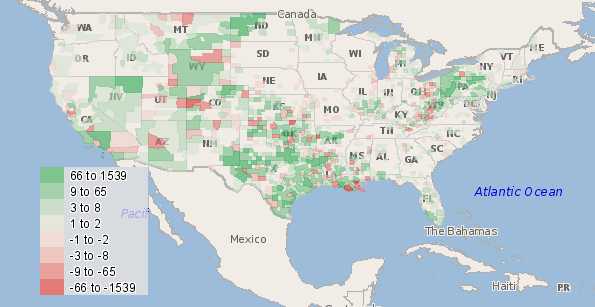
Where are these well-performing oil and gas jobs located? We mapped the data for the four fastest-growing jobs ? roustabouts, service unit operators, derrick operators, and rotary drill operators. Here?s what we found: Texas and Oklahoma of course have a large percentage of these jobs, but California, Alaska, and other Western states have a fair share, too.


The map below shows 2-year job growth in these oil and gas extraction jobs for every county in the continental US. Williams County, North Dakota is No. 1 with 1,539 jobs added, which amounts to 80% growth.


More Than a One-Year Trend


Mining, quarrying, and oil and gas extraction is expected to grow 6% in the US from 2010-2011. That?s the fastest projected growth among the 20 broadest-level industries?twice the rate in fact, as the next fastest-growing industry (administrative and support and waste management and remediation services,).


This is hardly a one-year bump, though. Over the last five years, the explosion in the sector has been than staggering?even with a minor employment dip from 2009-2010. The industry added more than 345,000 jobs nationally from 2007 to 2009, and is expected add another 85,000 this year, which equals 11% growth.


It?s also helpful to break out mining and oil and gas extraction from the broad sector to more specific industries to locate the real driver of the growth. In this case, it?s easy to see: Of the 506,401 new jobs in the sector since 2006, more than 431,000 have been in the crude petroleum and natural gas extraction industry (NAICS 211111). This sub-sector has grown by a whopping 113% nationally in the last six years while mining (except oil and gas) remains at its ?06 employment level.


Every state except for Maine has added jobs in crude petroleum and natural gas extraction since 2006, with Texas, Oklahoma, California, and Kansas leading the way.


The Rise of Contract Oil and Gas Workers


In last month?s GOVERNING Magazine, William Fulton wrote about the ?1099 economy??the shift by employers to hire temporary workers who file a 1099 form with the IRS rather than a W-2 and don?t receive benefits. No other industry has seen this move to 1099 workers more dramatically than mining, quarrying, and oil and gas extraction.


A recent EMSI analysis revealed that the share of 1099 workers in this sector increased from 33% in 2005 to 53% in 2010, the biggest percentage jump among the 20 broadest-level industries. Mining, quarrying, and oil, and gas extraction now has the third-highest share of contract workers, behind real estate (74%) and agriculture, forestry, fishing and hunting (68%).


At least part of this influx could be attributed to land owners cashing in on royalties after leasing their property for drilling. Through the quirks of how the Census? Bureau of Economic Analysis* tracks the oil and gas extraction industry ? and how the industry data is tied to occupations ? some of these jobs could be counts of landowners who are claiming additional income from oil and gas royalties. If that?s the case, these jobs would be better placed in the real estate and leasing industry.


Please note: For these reasons, EMSI ?noncovered? data (i.e., data on 1099 workers plus more traditional state data, etc.) for oil and gas jobs should be treated with caution. Also, the jobs numbers for 2010 are estimates at this point, so it will take more time to see how these trends play out.


*The Bureau of Labor Statistics measures only workers covered by unemployment insurance and who thereby file a W-2. EMSI?s ?complete? dataset adds proprietors and other ?noncovered? workers by combining BLS and state data with various Census datasets.


Joshua Wright is an editor at EMSI, an Idaho-based economics firm that provides data and analysis to workforce boards, economic development agencies, higher education institutions, and the private sector. He manages the EMSI blog and is a freelance journalist. Contact him here.


Lead illustration by Mark Beauchamp.


Full story at http://feedproxy.google.com/~r/Newgeography/~3/xYQjTT32wMo/002280-the-explosion-oil-and-gas-extraction-jobs

Saturday, January 30, 2010

The Fate of Detroit ? Revisited Green Shoots? The Changing Landscape of America

During the first ten days of October 2008, the Dow Jones dropped 2,399.47 points, losing 22.11% of its value and trillions of investor equity. The Federal Government pushed a $700 billion bail-out through Congress to rescue the beleaguered financial institutions. The collapse of the financial system in the fall of 2008 was likened to an earthquake. In reality, what happened was more like a shift of tectonic plates.


*******************************************************


By May of last year, when the first of this series appeared, it was clear that the American auto industry was about to fundamentally change. It has been just eight months and the changes have already been monumental. In 2009, China overtook America as the largest market for automobiles in the world. Sadly, America will never see that title again.


Industry CEOs flew into Washington, DC on their private jets asking for billions in federal hand-outs. They were chastised and embarrassed for their greed and insensitivity by politicians who have mastered that fine art of public outrage. GM?s CEO Rick Wagoner was publicly fired. The next day, GM put all eleven corporate jets on the market causing the resale market for G-5s to collapse overnight.


Since then, GM has entered and exited bankruptcy and senior debt holders were wiped out so the government could give ownership of GM to the UAW, in contravention of all existing bankruptcy laws. A thousand dealers were summarily terminated without compensation, or a hearing. The Saturn brand was snuffed out and the Saab brand will follow unless a miracle occurs ? an unlikely prospect. Pontiac and Hummer have already been terminated.


Chysler is now owned by Fiat, the government and the UAW. It too wiped out 1,000 loyal dealers without compensation, or a hearing. Chrysler sales, down 36%, were the worst since 1962. The company is on life support. The Italians will attempt to resuscitate the ailing brand with a fuel efficient Fiat 500 and curvaceous Alfa-Romero. Chrylser called on Lee Iacocca to help them recover in the 1980s. This time, they may need Sophia Loren to coax buyers back into the showroom.


Ford did not take TARP bail out money and the public responded by buying Ford products. While their sales were down 15%, they gained market share because GM and Chrysler sales were down 30% and 36% respectively. Sales in December were actually up 33% from a year ago. Ford dumped loser Volvo to the Chinese automaker, Geely, who coveted the domestic dealer network. Expect to see Chinese cars in an auto mall near you sooner rather than later.


Clunkers

Government showed its ignorance of the automible industry by sponsoring a Cash for Clunkers program. They will claim it was a great success, selling 677,842 new cars, but critics will remind that it cost $3 billion dollars. Edmunds.com reports that all but 125,000 sales would have taken place anyway. So taxpayers forked over about $24,000 per car for 125,000 sales. The National Highway Transportation Board reported that 20,000,000 barrels of oil will be saved over 20 years but critics will remind that we import that much in just two days. In addition, the cost to administer a program that lasted just six months was $100,000,000. The government was loathe to mention the top two brands purchased in the Cash for Clunkers progran were Honda and Toyota, not American brands.


Electrics

As promised, the government supported the move to electric vehicles. The U.S Department of Energy gave Tesla Motors a loan of $465 million to build the $87,900 electric Karma in California. Tesla claims it has sold 1,000 cars. That means Tesla sales represent a little over one hundredth of one percent of the domestic car business. The financial wisdom of such a loan would be questionable if it were not for the equally stunning announcement that Fisker would receive $529 million form the DOE to build its $100,000 electric car ? in Finland. Al Gore is a sharehholder of Fisker. Honda, which sells the $20,000 Insight hybrid vehicle and achieved just 25% of forecasted sales. If Honda has trouble selling a $20,000 electric hybrid, one wonders how many $100,000 electrics Fisker and Tesla models must be sold to repay our billion dollar loan.


Winners

The surprise winner of the last year was Korean car manufacturer, Hyundai. With a potent combo of great styling, affordable pricing on its Kia brand and new upscale products, Hyundai sales increased a surprising 10%. They project a 17% increase in 2010. Hyundai is doing so well it may spin off its own luxury brand, Genesis, as Toyota did so successfully with Lexus. The new Equus luxury sedan is about the same size as a large Mercedes, BMW or Lexus but $25,000 less. This basic formula worked to establish the Lexus and Infiniti brands in 1989. Expect it to be be repeated by Hyundai in the near future.


Green shoots

Even though it has relinquished its title as top dog to the Chinese, there are signs of life in the American automobile industry. Buick is the top brand in China and is resurgent in our domestic market. The new Buick Lacrosse and Regal are superb automobiles. Chevy rests its hopes on a trio of the new attractive products like an all electric Volt, a retro-styled Camaro and the 40 MPG Cruze. Cadillac released a new fleet of gorgeous CTS and SRX models and announced a new full-size XTS is on the way. Cadillac will get its own stunning version of the Volt called the Converj. And Government Motors (GM) announced it will invest a billion dollars to create the fuel efficeint trucks of the future in time for the economic recovery.


At Ford, they hope the 2011 Ford Focus will be a huge success. This small car is a move upscale for Ford. It has great styling and amenities, a higher price tag and therefore higher profits. Will Ford be able to sell an expensive small car to replace the profitable SUVs like the Explorer and Expedition?


Chrysler?s future is much murkier. A mini Fiat 500 is coming but the Alfa-Romeros have been delayed. The new Jeep Grand Cherokee and the Chrysler 300 are attractive, but the Chysler Lancia is simply weird. Chrysler revealed a new 200C EV, a surprise all electric concept. Will these models be enough to save Chrysler?. We will see.


The car business is changing. Green Shoots, as our president likes to muse. We hope he is correct.


***********************************


This is the seventh in a series on the Changing Landscape of America.


Robert J. Cristiano PhD is a successful real estate developer and the Real Estate Professional in Residence at Chapman University in Orange, CA.


PART ONE ? THE AUTOMOBILE INDUSTRY (May 2009)

PART TWO ? THE HOME BUILDING INDUSTRY (June 2009)

PART THREE ? THE ENERGY INDUSTRY (July 2009)

PART FOUR ? THE ROLLER COASTER RECESSION (September 2009)

PART FIVE ? THE STATE OF COMMERCIAL REAL ESTATE (October 2009)

PART SIX ? WHEN GRANNY COMES MARCHING HOME ? MULTI-GENERATIONAL HOUSING (November 2009)


Full story at http://feedproxy.google.com/~r/Newgeography/~3/AGf23y7H714/001380-the-fate-detroit-%E2%80%93-revisited-green-shoots-the-changing-landscape-america


Advertise with Us