PRESENTED BY PALAPPLE

ADVERTISE WITH US

Posted by iPhoto.org - Feb 26, 2009

Advertise here in this prominent space for only $100 per month, your advertisement will appear in all of the post pages available across this website.
Check out the link about for more advertisement options provided, get your message across!

Advertise with Us

SNAPSHOCK IS COMING TO TOWN

Posted by iPhoto.org On Feb 26, 2009

You better watch out,
You better bookmark,
You better ready your pics, cos I'm tell you why...

Snapshock is coming to town!!

Snapshock

THE BEST PLACE FOR DRY SEAFOOD

Posted by StarryGift On Mar 20, 2009

全香港其中一間最具規模的海味網上專門店。專營零售燕窩、鮑魚、海參、魚翅、花膠、元貝、冬蟲草,極具食療價值。此外亦提供各項中藥海味烹調方法,以導出各食品的固本培元及補生之效。

客戶服務熱線:3158 1276
傳真熱線:3158 1416
電郵查詢:info@starrygift.com

海味軒 | 香港燕窩海味網上專門店


Tuesday, August 31, 2010

3M gets 'a steal' in Cogent buyout, and some investors wonder why

Cogent Inc. investors and analysts sent a message to the Pasadena company?s founder on Monday: You?re selling the business too cheap.


Cogent, which makes biometric security systems that identify fingerprints, faces and eyeballs, said it had accepted an offer from conglomerate 3M Co. to buy the firm for $10.50 a share in cash, or $943 million.


Wall Street clearly thinks Cogent is worth more: The technology company?s shares jumped $2.18, or 24%, to close at $11.09 -- nearly 6% above 3M?s offer.


3M ?got a steal at this price,? said Brian Ruttenbur, an analyst who follows Cogent at brokerage Morgan Keegan & Co. in Nashville.


3M is actually paying only about $430 million for the business because Cogent is sitting with $513 million in cash on its balance sheet.


Minghsieh Cogent, founded by CEO Ming Hsieh in 1990, operates in an industry that is expected to post robust growth over the long run as national governments, local law enforcement agencies and companies focus on enhancing security. Not surprisingly, the U.S. Department of Homeland Security is a key Cogent customer.


Cogent?s systems, for example, allow border-control authorities and other government agencies to compare millions of fingerprints from far-flung computer databases in seconds.


But government decision-making on contracts can be tortuously slow, which can make sales unpredictable. Cogent?s revenue fell to $50 million in the first half of this year from $62.8 million in the same period of 2009, and net income slid to $7.8 million from $17.4 million.


Cogent also has been battling bigger competitors, including France?s Safran SA.


Still, Ruttenbur and other analysts said they saw more long-term value in Cogent than was reflected in 3M?s bid price. That has raised speculation that other companies with complementary technology, such as Northrop Grumman Corp. or L-3 Communications Holdings Inc., might emerge with counter-offers.


Ruttenbur said his investor clients were asking him about Cogent: ?Why now, and why this price??


But only Hsieh may know the answers to those questions, and he isn?t talking. For its part, 3M declined to comment on speculation that another bidder might emerge.


The 54-year-old Hsieh, a Chinese emigrant who came to the U.S. in 1980 to study at USC, has said that he was motivated to launch Cogent by the case of Richard Ramirez, the ?Night Stalker? convicted of murdering 13 people in L.A. in the mid-1980s. Hsieh read that the computerized fingerprint data processed by Japanese equipment helped authorities track down Ramirez.


?I wondered why an American company, like Hewlett Packard or IBM, could not do it,? he told the Times in a 2006 interview. That was the inspiration for Cogent.


Hsieh became an instant billionaire when Cogent went public in 2004 and the stock immediately jumped 50% on its first day of trading. Hsieh retained 60 million shares in the firm.


As with many new stock offerings, however, investors expected too much. The stock peaked at $35.75 in November 2004 and never again regained those heights. In the last few years it has mostly traded between $8 and $13 a share as investors have waited for Cogent to generate consistent growth (though the firm has always been profitable).


Ruttenbur thinks Hsieh, who has largely shunned publicity, ?got tired of being a public-company CEO.? But going public also allowed Hsieh to cash out of huge portion of his holdings in Cogent -- at least $350 million since 2004, Ruttenbur estimates.


Hsieh, who has been a major benefactor of both USC and West Virginia University, still directly owns nearly 39% of Cogent, or 34.4 million shares worth $361 million if the 3M deal goes through. Ruttenbur believes Hsieh owns additional stock via trust accounts. So no deal can happen unless Hsieh agrees -- and he?s obviously content with the 3M offer, even if other shareholders may not be.


-- Tom Petruno


Photo: Cogent Inc. CEO Ming Hsieh in 2008. Credit: Gary Friedman / Los Angeles Times


Full story at http://feeds.latimes.com/~r/MoneyCompany/~3/kUr3rpmQiYE/cogent-3m-ming-hsieh-pasadena-takeover-biometrics-homeland-security.html

Democracy in America

A

Full story at http://baselinescenario.com/2010/08/26/democracy-in-america/

Central Clearing and Systemic Risk

A

Full story at http://baselinescenario.com/2010/08/30/central-clearing-and-systemic-risk/

Nintendo's New DS Pricing Strategy

Filed under: ,

I just read that Nintendo Co., Ltd. (NTDOY) has decided to make its higher-end handheld hardware a little cheaper for consumers. According to TheFly, the Nintendo DSi and the Nintendo DSiXL will sport a cost of $149.99 and $169.99 beginning September 12, respectively. That's $20 less than the old price.


Now, you would have thought that the Nintendo DS Lite would have seen its price reduced as well, but I'm sorry to say you'd be wrong. That unit will remain at $129.99. I guess Nintendo is sending a strong message: go for the higher-end models.

Continue reading Nintendo's New DS Pricing Strategy

Nintendo's New DS Pricing Strategy originally appeared on BloggingStocks on Mon, 30 Aug 2010 17:50:00 EST. Please see our terms for use of feeds.

Read | Permalink | Email this | Comments


Add to digg
Add to del.icio.us
Add to Google
Add to StumbleUpon
Add to Facebook
Add to Reddit
Add to Technorati


Nintendo DSi - Nintendo - Nintendo DS Lite - Nintendo DS - Handheld game console

Full story at http://www.pheedcontent.com/click.phdo?i=49196dca8e55836e1bf8f4ccf2651efa

ADVERTISEMENT:

Full story at http://ads.pheedo.com/click.phdo?s=0590b731ded6480a6ba691577736f19d&p=4

Option Traders Buy Cobalt International Energy Calls and Mirant Puts

Filed under: ,

Option traders appear to be setting up for a bullish move on Cobalt International Energy, Inc. (CIE). Traders plowed into 1,553 new call option contracts -- 4.65 times the average volume -- on the stock on Monday. And we know that traders were eager to get into this trade because 98% of the trades came in on the ask price.


Cobalt just bounced up off of support at $7. The stock closed Monday at $8.25, down 1.32% during the past month.


Option traders also look like they are preparing for a bearish move on Mirant Corporation (MIR). Traders bought 1,006.00 new put option contracts -- 6.75 times the average volume -- on the stock. A full 100% of these trades also came in on the ask price.


The stock closed Monday at $9.63, down 12.22% during the past month.

Continue reading Option Traders Buy Cobalt International Energy Calls and Mirant Puts

Option Traders Buy Cobalt International Energy Calls and Mirant Puts originally appeared on BloggingStocks on Mon, 30 Aug 2010 18:20:00 EST. Please see our terms for use of feeds.

Permalink | Email this | Comments


Add to digg
Add to del.icio.us
Add to Google
Add to StumbleUpon
Add to Facebook
Add to Reddit
Add to Technorati


BloggingStocks - Put option - Call option - Trade - Market sentiment

Full story at http://www.pheedcontent.com/click.phdo?i=0590b731ded6480a6ba691577736f19d

How The Recent Financial Crisis Stands Up To The Last Century's Greatest Crises

The various presentations delivered at the recent KC Fed Jackson Hole summit are now up, and the one folks are buzzing about the most is the one from Carmen and Victor Reinhart titled After The Fall (.pdf), which places the recent economic and financial crisis in context.


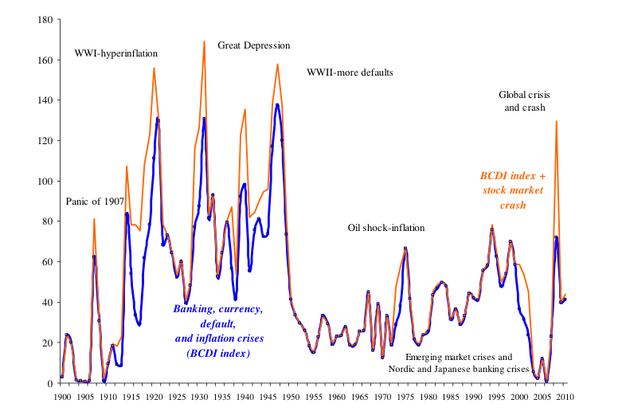
This chart, which attempts to create a common way of comparing crises is interesting.


Here's how it's explained:


Varieties of crises: World aggregate, 1900-June 2010 A composite index of banking, currency, sovereign default and, inflation crises, and stock market crashes (weighted by their share of world income)


The banking, currency, default (domestic and external) and inflation composite (BCDI index) can take a value between 0 and 5 (for any country in any given year) depending on the varieties of crises taking place on a particular year. For instance, in 1998 the index took on a value of 5 for Russia, as there was a currency crash, a banking and inflation crisis, and a sovereign default on both domestic and foreign debt obligations. This index is then weighted by the country’s share in world income. This index is calculated annually for the 66 countries in the sample for 1800-2010:6 (shown above for 1900-onwards). We have added, for the borderline banking cases identified in Laeven and Valencia (2010) for the period 2007-2010. In addition, we use the Barro and Ursua (2009) definition of a stock market crash for the 25 countries in their sample (a subset of the 66-country sample-except for Switzerland) for the period 1864-2006; we update their crash definition through June 2010, to compile our BCDI+ index. For the United States, for example, the index posts a reading of 2 (banking crisis and stock market crash) in 2008; for Australia and Mexico it also posts a reading of 2 (currency and stock market crash).


crisis crises reinhart

Join the conversation about this story »


Full story at http://feedproxy.google.com/~r/businessinsider/~3/SNSR0qW0YV0/reinhart-bcdi-index-2010-8


Advertise with Us